
In 2023, a leading global EV automaker launched an electric commercial vehicle offering a range of 300 km (approximately 186 miles) and support for DC fast charging. In 2025, the automaker expanded its electric commercial vehicle lineup with an independently developed electric truck featuring Level 2 advanced driver assistance systems (ADAS). With this new vehicle, the automaker also encountered new testing challenges.
New Challenges in Full-Vehicle Validation as EV Systems Become Highly Integrated
Traditional vehicle development has focused on testing individual components first, then integrating them into a physical vehicle for validation. Today, with increasing vehicle electrification and intelligence, vehicles rely on motor drive systems, battery management systems (BMS), onboard chargers (OBC), air-conditioning control systems, and numerous electronic control units working together.
With high- and low-voltage systems interconnected, thorough validation is required to verify the stable, coordinated operation of the entire system. If full-vehicle validation is conducted only after the physical vehicle has been built, cross-system issues often do not surface until road testing, increasing debugging costs and affecting the development schedule.
Building a High-Power Vehicle Simulation Lab with Power HIL and Dynamometer Testing
To enable full-vehicle validation earlier in the development process, Chroma’s SimuEV full-vehicle test platform helped the automaker establish a high-power laboratory for virtual vehicle testing, integrating Power HIL and dynamometer test platforms.
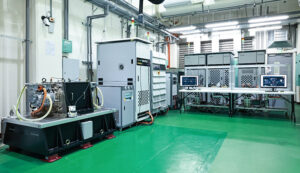
The Power HIL platform recreates real high-voltage power interactions for the OBC and DC-DC converter, while the Dyno bench integrates two motor devices under test (DUTs) to reproduce vehicle load conditions during operation.
The air-conditioning test system can also be used to verify the energy efficiency and operating performance of EV air-conditioning components.
Together with a full-vehicle model, real-time control system, battery simulator, and physical battery, these test systems enable the various subsystems to operate together according to the full-vehicle architecture and support durability testing.
Depending on test requirements, engineers can switch between a physical battery and a simulated battery, connect different DUT components, or use models in place of systems that are still under development, allowing flexible configuration of different test environments.
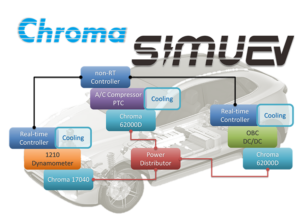
▲ Chroma SimuEV connects multiple Power HIL systems for full-vehicle simulation.
From Subsystems to Full-Vehicle Validation: Identifying Issues Before Road Testing to Accelerate Development
As the test environment enables full-vehicle testing, the approach to validation also changes. Engineers can repeatedly reproduce different road-load conditions, charging/discharging strategies, and controller versions.
They can also introduce high-voltage faults, communication interruptions, and controller anomalies to examine how subsystems respond to one another.
For example, engineers can simulate vehicle charging while the air-conditioning system remains active, allowing them to evaluate vehicle-level energy-management safety logic and energy monitoring under realistic operating conditions.
The challenge is not simply connecting more test equipment, but enabling the subsystems to work together as they would in a real vehicle and creating a test platform that supports full-vehicle operation.
Many issues that once surfaced only during road testing can now be identified, verified, and corrected earlier in the R&D process, allowing engineering teams to focus more resources on product validation.
Built on years of industry experience with Power HIL test platforms and dynamometer solutions, Chroma’s SimuEV system integration approach meets the diverse validation needs of customers.
Validation can progress from components and subsystems to the full-vehicle level on the same platform, effectively bringing full-vehicle validation into the laboratory at an earlier stage. This accelerates product development while improving system integration reliability.
Click below to learn how Chroma’s 8620 OBC/DC-DC Converter Power HIL Testbed supports EV development and validation.