
As AI reshapes the digital world, another revolution is quietly unfolding in the physical world. Global logistics is moving toward a new era of autonomous operation and full electrification.
With Tesla set to begin volume production of the Semi truck at Gigafactory Nevada and start deliveries in 2026, the land transportation industry is entering a new phase. Battery-electric trucks offer higher energy efficiency and lower carbon emissions, while autonomous driving technologies could enable 24-hour continuous transportation and reduce the risks associated with driver fatigue on long-haul routes. However, the key prerequisite for realizing this vision is a fast and reliable megawatt-level charging system.
A Key Driver of Commercial EV Adoption: Low Cost of Ownership
Mone Transport, a logistics company based in Texas, U.S., officially reported an impressive energy consumption of 1.64kWh/mile after 4,700 miles of validation testing with the Tesla Semi.1
Battery-electric truck cost: approximately 15 cents per mile
Conventional diesel truck cost: approximately 48 cents per mile
Taken together, the roughly threefold difference in transportation costs, the simpler architecture of battery-electric vehicles (BEVs), and the substantial reductions in maintenance and repair time and costs are set to be decisive factors driving transportation companies worldwide toward electrification.
Heavy-Duty Transportation Enters the Megawatt Charging Era
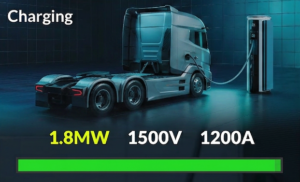
Compared with passenger vehicles, heavy-duty trucks must accommodate higher payloads and longer operating distances while keeping charging times as short as possible. Traditional charging systems rated at several hundred kilowatts are no longer sufficient to meet these demands. To address this need, CharIN, the global EV charging standards organization, developed the MCS (Megawatt Charging System) specification to support charging power of 1MW and beyond. MCS marks the beginning of a new era of megawatt-level power applications in transportation infrastructure. However, as charging power reaches the MW level, the complexity and risks of system validation also increase exponentially.
The Challenges Behind Megawatt Charging: High Power, High Current, High Risk
Megawatt-level charging presents unprecedented challenges for the test environment, including high-voltage DC protection, thermal management under high-current conditions, and stable operation under sustained high loads. These challenges are especially significant in autonomous electric truck applications, where even a momentary voltage anomaly or control failure could damage equipment or disrupt logistics operations. In megawatt charging, charging speed is only the baseline. What truly determines a system’s value is its stability and reliability over extended operation.
Advanced Power Test Solution: Chroma 62450D-2000HL
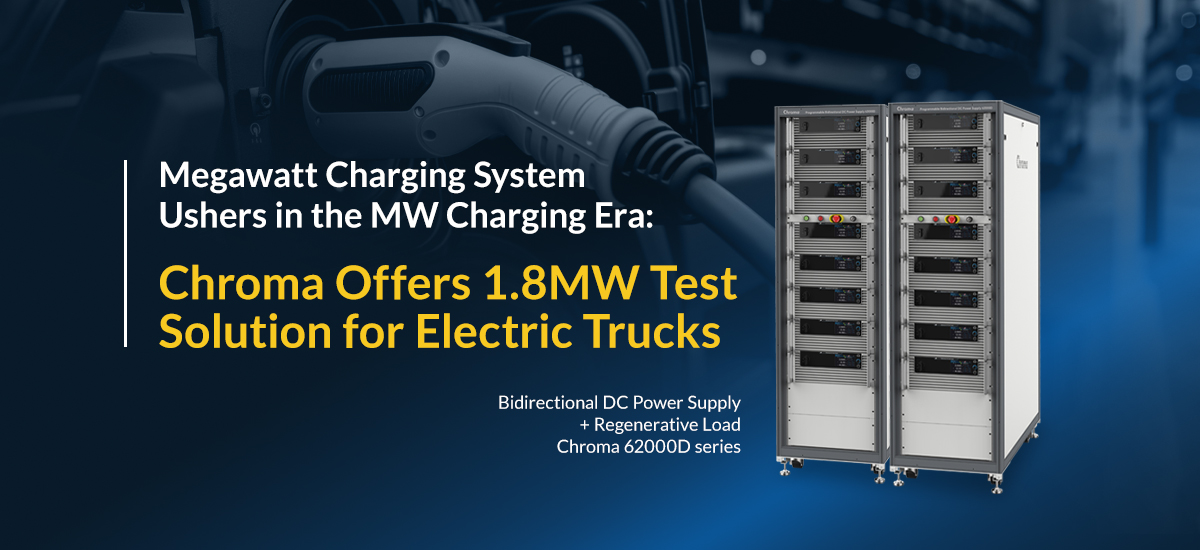
Designed for heavy-duty electric trucks and MCS systems, the Chroma 62000D Series (1.8MW Bidirectional DC Power Supply and Regenerative Electronic Load) meets the stringent requirements of high-power EVs and MCS specifications.
- Megawatt-Level Power Scalability: Multiple high-power units can be connected in parallel to support test requirements of 1.8MW and beyond, enabling accurate simulation of the extreme dynamic load conditions of commercial vehicle traction batteries and charging stations.
- Up to 94% Energy Regeneration Efficiency: During high-power testing, the Chroma 62000D returns energy discharged by the DUT (Device Under Test) to the grid at an efficiency of up to 94%. This not only addresses the substantial heat generation and dissipation challenges associated with high-power laboratory testing but can also save customers millions in annual electricity costs, enabling green and sustainable testing.
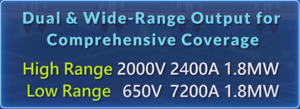
Unique Advantage: Dual & Wide-Range Output for Comprehensive Coverage of Mainstream Battery Platforms
The 62000D-HL features a unique dual-range output design. Its wide operating range enables DUTs to be tested at full power under both high-current and high-voltage conditions, while supporting battery platforms including 400V, 800V, and 1500V.
System Solution: Chroma 8000 Automatic Test System
The Chroma 8000 ATS provides system integration capabilities tailored for high-current and liquid-cooled charging tests, enabling stable, prolonged testing under high-current output conditions. Its highly reliable power switching design helps reduce the risk of test interruptions, making it particularly well suited for validating liquid-cooled charging connectors and high-power modules, as well as for megawatt-level charging validation. To learn more about high-current and liquid-cooled EV charging tests, see: [Chroma Targets Next Gen EV Charging Standards with ISO 15118 20 and Liquid Cooled, High Current Charging Test Solutions]
From AI to Smart Logistics: Reliable Power Is the Key
Future logistics hubs will become intelligent infrastructure driven by energy, computing power, and high-power electrical systems. Amid this transformation, autonomous heavy-duty electric trucks are becoming a major focus for industries worldwide, and the greatest challenge they face is power. Chroma continues to advance innovative high-power testing technologies, helping partners around the world embrace a new revolution driven by the convergence of energy and transportation.
Watch the video to see how Chroma’s innovative power test solutions are helping advance megawatt-level charging:
Chroma 62000D Series Bidirectional DC Power Supply
| Note 1: https://www.linkedin.com/posts/mone-transport_mone-transport-recently-had-the-opportunity-activity/ |