
LCR Meters for Precise Measurement of Inductance, Capacitance, Resistance, and Impedance
Chroma LCR meters provide precise measurement of inductance (L), capacitance (C), resistance (R), impedance, and other electrical characteristics of passive components. Designed for engineering laboratories, R&D, quality assurance, incoming inspection, and production testing, Chroma LCR meters combine accurate measurements with programmable test frequencies, flexible test signal levels, and fast measurement speeds.
From general-purpose component characterization to high-frequency RF testing, Chroma offers LCR measurement solutions for capacitors, inductors, resistors, transformers, filters, and other passive electronic components.
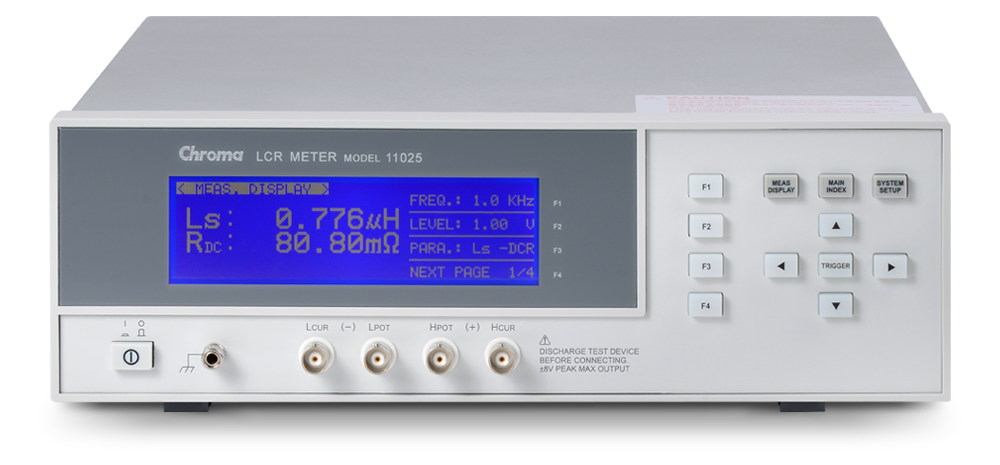
What Is an LCR Meter?
An LCR meter is an electronic test instrument used to measure the electrical properties of passive components, primarily inductance (L), capacitance (C), and resistance (R). Unlike a basic digital multimeter, an LCR meter applies an AC test signal to the device under test and evaluates its impedance characteristics at a specified frequency. Depending on the instrument and application, an LCR meter can also measure parameters such as Impedance (Z), Reactance (X), Conductance (G), Susceptance (B), Quality factor (Q), Dissipation factor (D), Phase angle, and Equivalent series resistance (ESR)
Because component behavior can change considerably with frequency and signal level, selecting an LCR meter with the appropriate frequency range, test voltage, accuracy, and measurement speed is important for reliable component characterization.
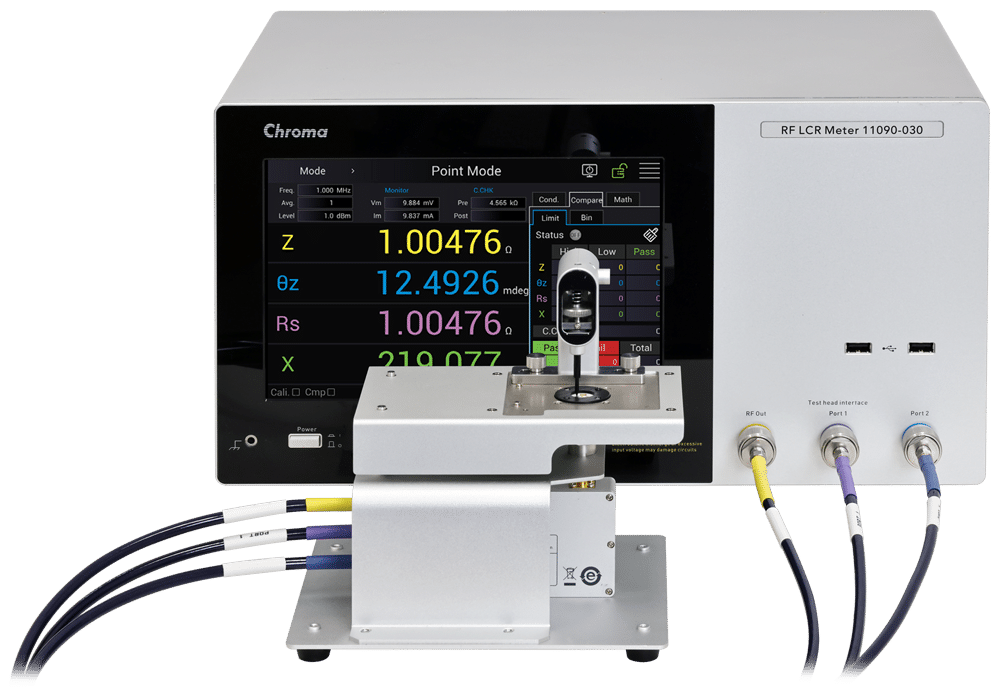
How to choose the right LCR meter
Compare Chroma LCR Meters
Start with the test frequency required for the component and application. Then consider measurement accuracy, test signal level, measurement speed, impedance parameters, automation requirements, and whether the instrument will be used for benchtop characterization, incoming inspection, quality assurance, or high-speed production testing. The guide below helps engineers choose the right Chroma LCR meter for general passive component testing, precision impedance measurement, high-frequency characterization, RF components, and capacitor testing.
Need a general-purpose LCR meter?
Start with the 11021/11021-L for fundamental capacitance,
inductance, resistance, and impedance measurements.
Need precision and programmability?
Use the 11022/11025 when programmable test signal levels,
precision measurements, and automated test integration matter.
Testing high-frequency components?
Use the 11050 Series when component characterization must extend
into the MHz range, with models supporting frequencies up to 30 MHz.
Testing RF components?
Use the 11090-030 for SMD inductors, RF filters, and other passive
components requiring measurement frequencies up to 300 MHz.
| Product family | Frequency | Test signal | Accuracy | Speed | Best fit | Why choose it | Next step |
|---|---|---|---|---|---|---|---|
|
11021 / 11021-L
LCR Meter
|
100 Hz–50 kHz |
11021: 0.25 V / 1 V 11021-L: 50 mV / 1 V |
0.1% / 0.2% | 75 ms | General-purpose capacitor, inductor, resistor, and impedance testing for engineering benches, incoming inspection, QA, and production environments. |
Best entry point
Choose this family for straightforward LCR measurements when wide RF frequency coverage or advanced programmable stimulus levels are not required. |
Explore |
|
11022 / 11025
Precision LCR Meter
|
50 Hz–100 kHz |
10 mV–1 V 10 mV steps |
0.1% | 21 ms | Precision component characterization, R&D, quality assurance, incoming inspection, production testing, and automated test systems. |
Best programmable LCR
Choose this family when programmable test signal levels, voltage/current monitoring, measurement accuracy, and automated workflows are important. |
Explore |
|
11050 Series
High-Frequency LCR Meter
|
Up to 30 MHz | 10 mV–5 V | 0.1% | 15–295 ms | High-frequency capacitors, inductors, resistors, magnetic components, power electronics, R&D, and production characterization. |
Best high-frequency LCR
Use when component impedance, quality factor, loss characteristics, or other electrical parameters must be evaluated into the MHz range. |
Explore |
|
11090-030
RF LCR Meter
|
100 kHz–300 MHz | -40 dBm–1 dBm | High-accuracy RF measurement | 0.5 ms | SMD chip inductors, RF filters, communications components, RF passive devices, high-speed production testing, and high-frequency R&D. |
Best for RF
Choose the 11090-030 when component characterization requires RF frequencies up to 300 MHz and very fast measurement throughput. |
Explore |
|
11200
Capacitor Leakage Current / IR Meter
|
Leakage current / insulation resistance |
1–100 V in 0.1 V steps Higher-voltage ranges in 1 V steps |
0.3% | 77–420 ms | Capacitor leakage-current testing, insulation-resistance measurement, QA, production lines, and benchtop capacitor evaluation. |
Best for capacitor leakage
Use when capacitor testing requires leakage-current or insulation-resistance measurements beyond conventional capacitance and impedance testing. |
Explore |
No products match this filter. Select another application or view all LCR meters.
Not sure which LCR meter fits your test requirements?
Share your component type, test frequency, required accuracy,
test signal level, measurement speed, impedance parameters,
and automation requirements with a Chroma sales engineer.
Get help choosing
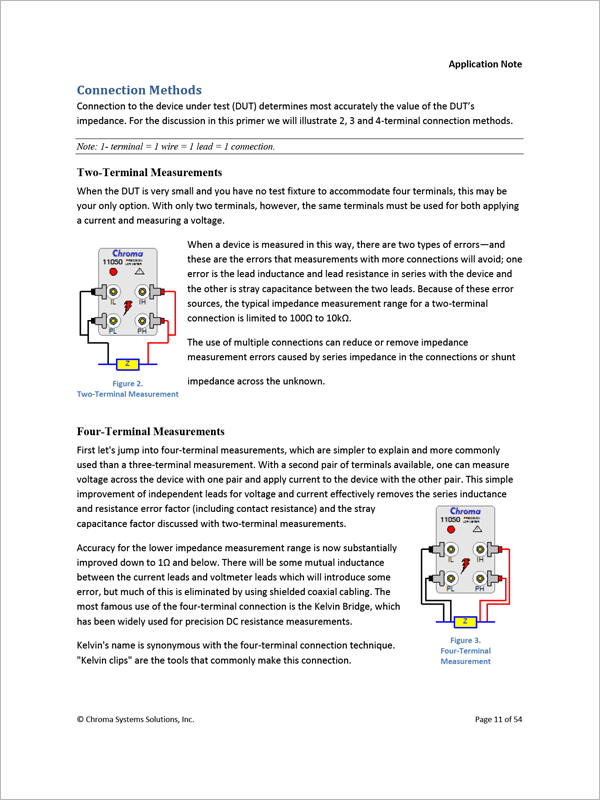
White Paper: LCR Measurement Primer
What is Impedance? What are the measurements of Impedance? This primer defines and explains the measurement of the impedance parameters known as L (inductance), C (capacitance), and R (resistance). Impedance parameters are characteristic of an AC circuit; this primer describes the impedance measurements that are typically used, including their equations.
LCR Meter FAQ's
What does an LCR meter measure?
An LCR meter primarily measures inductance (L), capacitance (C), and resistance (R). More advanced instruments can also calculate impedance, reactance, phase angle, quality factor, dissipation factor, ESR, and other parameters used to characterize passive electronic components.
What is the difference between an LCR meter and a multimeter?
A digital multimeter commonly measures quantities such as DC resistance, voltage, and current. An LCR meter applies an AC test signal at a specified frequency so that it can characterize the impedance behavior of capacitors, inductors, resistors, and other passive components.
Why does frequency matter when using an LCR meter?
Passive components do not always behave the same way at every frequency. Parasitic capacitance, inductance, ESR, resonance, and other effects can influence measurements. Testing at a frequency close to the component’s intended operating conditions generally provides a more representative measurement of its electrical behavior.
Can an LCR meter measure ESR?
Yes. LCR meters capable of measuring equivalent series resistance can be used to evaluate ESR, an important parameter for capacitors and other components where losses affect circuit performance.
Can an LCR meter test inductors?
Yes. Inductor measurement is one of the primary applications for an LCR meter. Depending on the instrument, engineers can measure inductance along with parameters such as resistance, impedance, quality factor, and phase angle.
Can an LCR meter test capacitors?
Yes. LCR meters are widely used for capacitor testing and can measure capacitance along with characteristics such as dissipation factor, ESR, impedance, and phase. Dedicated equipment may also be used when capacitor leakage current or insulation resistance needs to be evaluated.
What frequency LCR meter do I need?
The appropriate frequency range depends on the component and its intended application. General passive-component testing may require frequencies in the Hz or kHz range, while components used in switching electronics may require MHz measurements. RF inductors, filters, and similar devices may require measurement frequencies extending into hundreds of megahertz.
What is the difference between an LCR meter and a multimeter?
A digital multimeter commonly measures quantities such as DC resistance, voltage, and current. An LCR meter applies an AC test signal at a specified frequency so that it can characterize the impedance behavior of capacitors, inductors, resistors, and other passive components.
What is a high-frequency LCR meter?
A high-frequency LCR meter measures impedance and related component characteristics at frequencies extending into the MHz range. These instruments are useful for evaluating components whose electrical behavior changes significantly as operating frequency increases.