Digital Power Meters

Digital Power Meters for Accurate AC/DC Power Measurement

Chroma digital power meters provide high-accuracy measurement of voltage, current, power, energy, harmonics, power factor, and other critical electrical parameters for power electronics testing. Designed for both single-phase and multi-phase applications, Chroma power meters support R&D, design verification, quality assurance, production testing, and automated test systems.

With high-speed digital signal processing and sampling rates up to 250 kHz, Chroma power meters provide fast, repeatable measurements across a wide range of electronic devices and power conversion products. Single-channel and multi-channel configurations are available for measuring AC and DC power from low-power standby consumption to three-phase power systems.

Digital Power Meters & Power Analyzers

How to choose the right Power Meter

Compare Chroma Power Meters and Analyzers

Compare Chroma digital power meters by channel count, voltage range, current range, wiring configuration, and application to find the right instrument for your AC/DC power measurement requirements.

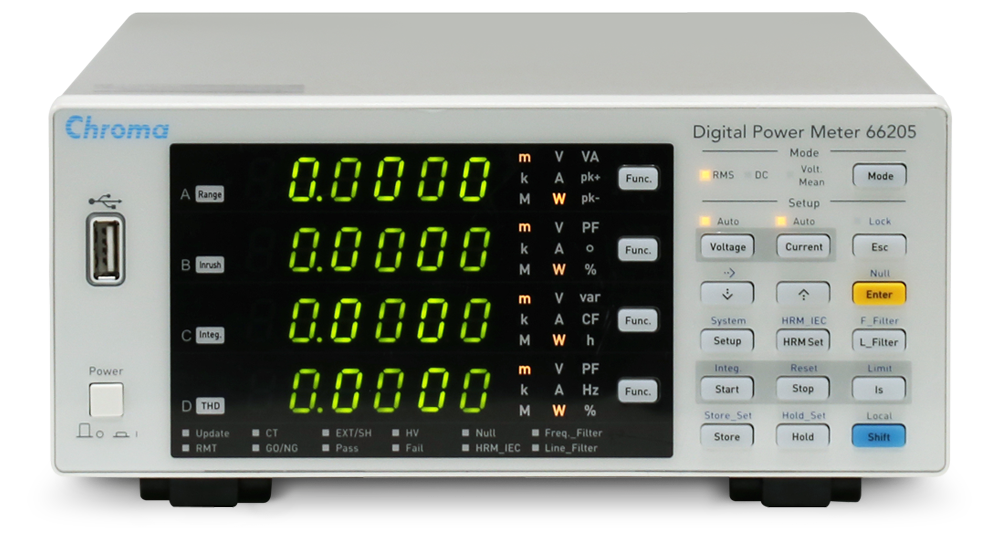
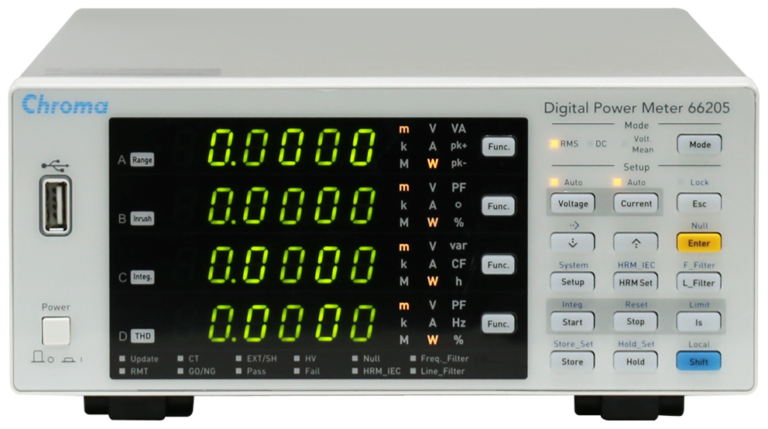
Need general AC/DC power measurement? Choose the 66205 for single-channel power measurement up to 30 Arms, including power, power factor, harmonics, THD, energy, and inrush current measurements.
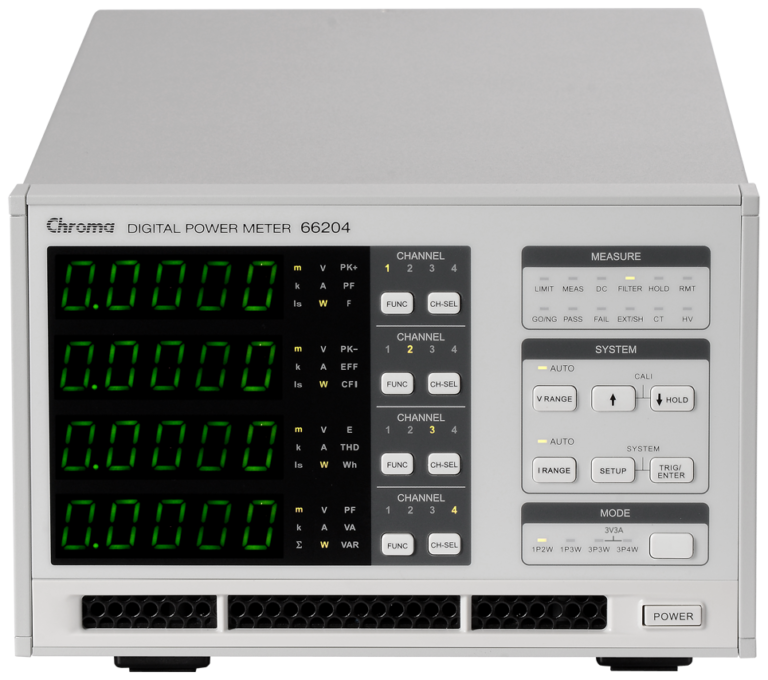
Need three-phase or multiple measurements? Choose the 66203 or 66204 for three- or four-channel measurements and single- or three-phase wiring configurations including 3P3W and 3P4W.
Comparison of Chroma programmable AC power supply families by power, voltage, frequency, application, and selection criteria.
Product Series Voltage Current Frequency Best fit Why choose it Next step
66205 Single ChannelDigital Power Meter
15 / 30 / 60 / 150 / 300 / 600 Vrms (1200 Vrms optional) Up to 30 Arms DC, 15 Hz–10 kHz Single-phase power supplies, adapters, appliances, standby power, power conversion products, R&D, and automated testing. ENERGY STAR
Ideal single-channel power meter for precision AC/DC measurement, harmonics, THD, inrush current, energy measurement, and IEC 62301 / ENERGY STAR testing.
Explore
66203/66204 Multi ChannelDigital Power Meters
15 / 30 / 60 / 150 / 300 / 600 Vrms Up to 20 Arms DC, 15 Hz–10 kHz Three-phase power systems, inverters, power conversion equipment, efficiency testing, R&D, QA, and automated test systems. Various wiring modes
Best choice for multi-channel and three-phase applications with 1P2W, 1P3W, 3P3W, 3P4W, and 3V3A wiring configurations.
Explore

No products match this filter. Select another capability or view all AC power supplies.

What Is a Digital Power Meter?

A digital power meter is a precision measurement instrument used to measure the electrical characteristics and power consumption of a device or power system. Unlike basic voltage or current meters, a power meter simultaneously analyzes voltage and current waveforms to calculate parameters such as real power (W), apparent power (VA), reactive power (VAR), power factor (PF), energy (Wh), frequency, phase angle, crest factor, and harmonic distortion.

Power meters are commonly used when evaluating AC/DC power supplies, adapters, inverters, industrial electronics, consumer products, LED drivers, and other power conversion equipment where accurate power and efficiency measurements are required.

66203 and 66204 Digital Power Meters & Power Analyzers

Why Use a Precision Digital Power Meter?

Accurate power measurement provides more information than measuring voltage and current independently. Simultaneous waveform measurement allows engineers to evaluate the relationship between voltage and current and determine true power, power factor, phase, harmonics, and energy consumption.

This becomes particularly important when testing switching power supplies, inverters, LED drivers, and other nonlinear loads where current waveforms may differ significantly from the input voltage waveform.

A precision digital power meter helps engineers:

  • Verify product energy consumption
  • Measure conversion efficiency
  • Analyze power factor
  • Identify harmonic distortion
  • Capture inrush current
  • Compare operating modes
  • Characterize low-power and standby operation
  • Validate single- and three-phase products
  • Automate power measurements during production testing