
With the maturity of advanced driver-assistance system (ADAS) technology, the proportion of electronic and electrical systems applied to the automotive field is gradually increasing, as is their impact on its safety. Once the electronic system has a functional failure, it could cause an accident and endanger the vehicle or passengers. In 2011, the ISO 26262 standard on the functional safety of road vehicles was released to assist car manufactures and component suppliers in ensuring the functionality of their products through hazard analysis and risk assessment (HARA). When a product encounters any abnormality, it can implement a safety mechanism within the designated time frame and enter a safe state. This will greatly reduce the damage that may be caused by possible function failure during driving.
Due to the long development cycle of automotive electronic products, it takes high testing costs and risks. How to ensure that the product development process meets the functional safety standards remains a topic of high concern for manufacturers. The hardware-in-the-loop (HIL) test described in ISO 26262 serves to verify the functions, communication, and system integrity of the electronic control unit (ECU). In the automotive field, a vehicle model and related environment are set up to simulate various working conditions and run them with the controller in a closed-loop real-time system, thereby carrying out both basic and complex test scenarios for each ECU.
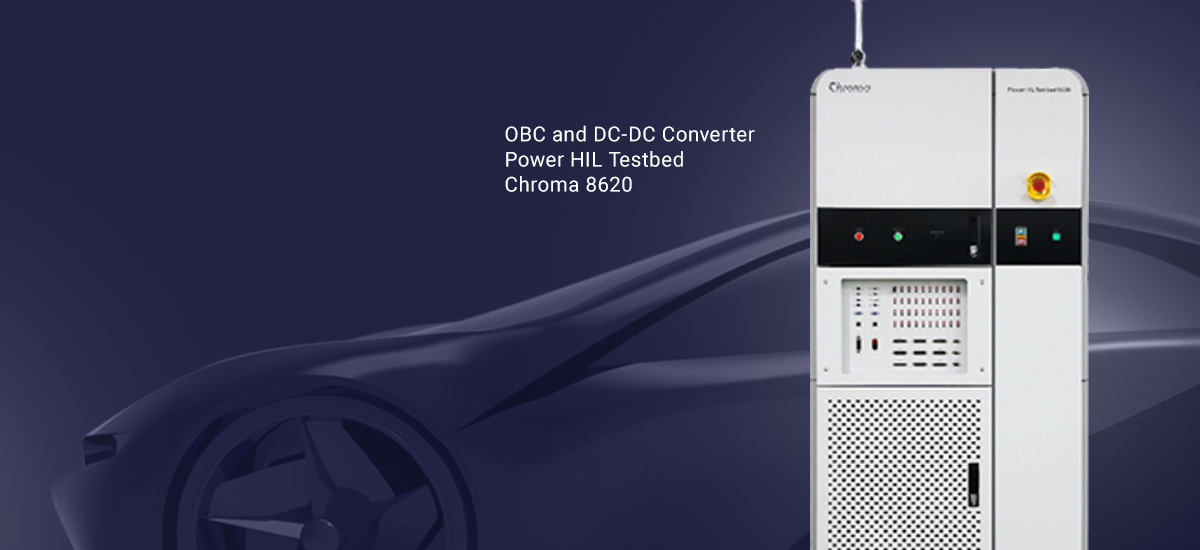
A well-known Taiwanese manufacturer of power supply for electric vehicles (EV) has adopted Chroma 8620 testbeds to improve their ISO 26262 process and conduct power-level HIL testing on DC-DC converters. The testbed not only performs test items according to the GB/T 24347 standard but also conducts thorough testing on the normal and abnormal functionalities as well as failure modes of the DC-DC converters. Moreover, adding the vehicle model allows for more test conditions such as abnormal start-up time, and accelerator pedal and brake pedal depth changes to simulate the driver’s behavior. The manufacturer can, for example, observe whether the DC-DC converter is working normally, or whether it can enter the safe mode smoothly when encountering an abnormal state.
Chroma 8620 provides a customizable user interface (UI) that can be configured according to specific DC-DC converter functions and test conditions. On the UI, users can observe the changes in the parameters and graphs, manually adjust the test items, and quickly modify DC-DC converter functions or test processes. The testbed can also be used with automated test software to accomplish test projects with lengthy or tedious procedures. After the test is completed, automatic report generation lets users directly confirm the test results for improved test efficiency and convenience.
Aiming to improve the performance of EVs, major manufacturers across the world are eagerly enhancing charging and power system technologies for EV. From the external charging station to the internal on-board charger, power battery system, DC-DC converter, drive controller, and motor, each part must successfully undergo complete testing and verification to ensure its safety.
Chroma has long been deeply involved in testing applications for the EV industry. We provide a series of ATS solutions that can test most power components in the EV power system. Chroma’s highly integrable test solutions have been recognized and adopted by first-tier customers in the EV industry.