
As global net-zero initiatives advance and the energy transition accelerates, high-voltage battery technology has become a focal point in both energy storage and electric vehicle (EV) industries. By enhancing conversion efficiency and reducing energy loss, this technology plays a key role in achieving sustainable energy goals.
In the energy storage sector, the industry is now adopting 1500V high-voltage designs with liquid cooling. This is to support megawatt-level output power and stable, long-duration power delivery while ensuring efficient energy storage and delivery. Leading companies such as Huawei, Wärtsilä, and Samsung SDI have all implemented this architecture in their energy storage cabinets.
In contrast, the EV industry is driven by the demand for high current output and fast charging. This has led to a transition from mainstream 400V platforms to 800V systems and higher. Global automakers such as Tesla, Porsche, and Mercedes-Benz, as well as Chinese manufacturers like BYD and GAC, have adopted 800V architectures to enhance power performance and support faster charging. Moreover, high-voltage platforms are expanding into heavy-duty machinery like John Deereˈs electric excavators, reflecting the broadening application of high-voltage battery technologies. These trends highlight the diverging voltage architectures and testing requirements across different domains, each presenting unique challenges and opportunities.
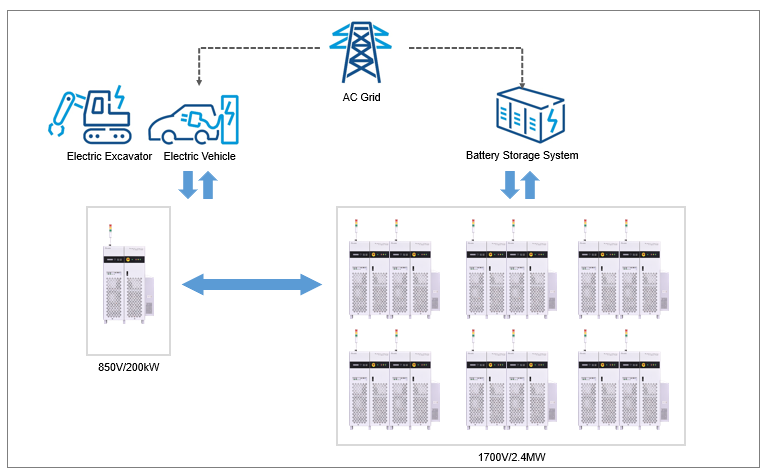
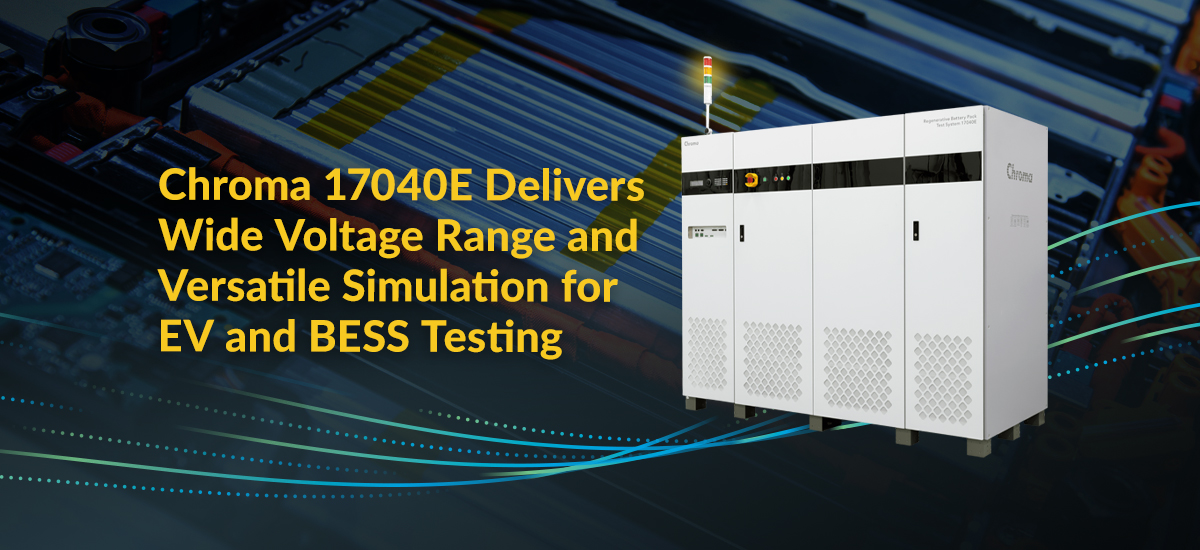
The Chroma 17040E Battery Pack Test System features energy recovery capability with more than 93% efficiency, enabling significant energy savings, reducing harmonic distortion, and eliminating the heat and waste associated with traditional discharge methods—all in line with modern environmental standards. With a voltage rating of 850V, the 17040E supports mainstream 400V EV systems as well as 800V platforms used in premium EVs and construction vehicles. It also provides realistic simulation of actual current and power profiles via Waveform mode. With a 1ms (10% → 90%) current response speed, the system delivers stable current transitions when switching between charge and discharge mode, allowing precise replication of dynamic, real-world driving scenarios.
The 17040E also offers a versatile range of fixture configurations to meet diverse product testing requirements. It supports both series and parallel connections for wide-voltage, multi-scenario applications. With a maximum output voltage of 1700V and output power up to 2.4MW, the system fully satisfies the performance testing and safety verification needs of high-voltage, megawatt-level BESS.
By combining energy regeneration and a wide voltage operating range, the Chroma 17040E bridges the testing needs of both energy storage and EV applications. This solution minimizes replacement of equipment due to tech upgrades or shifting requirements, cutting procurement costs and maximizing overall ROI—helping users stay agile in a fast-evolving market.