Exploring Partial Discharge Tester

Partial Discharge Tester - 19501

Partial Discharge Tester

Chroma 19501

Provides AC Hi-Pot test to measure leakage current and flashover, and partial discharge (PD) test to measure the charge (pC) of PD on the device under test (DUT)

Test Time

0.3 to 99.9 sec., steps 0.1 sec.

Accuracy

±(0.2% of setting + 10ms)

PD detection delay time

0 to 99.9 sec., steps 0.1 sec.

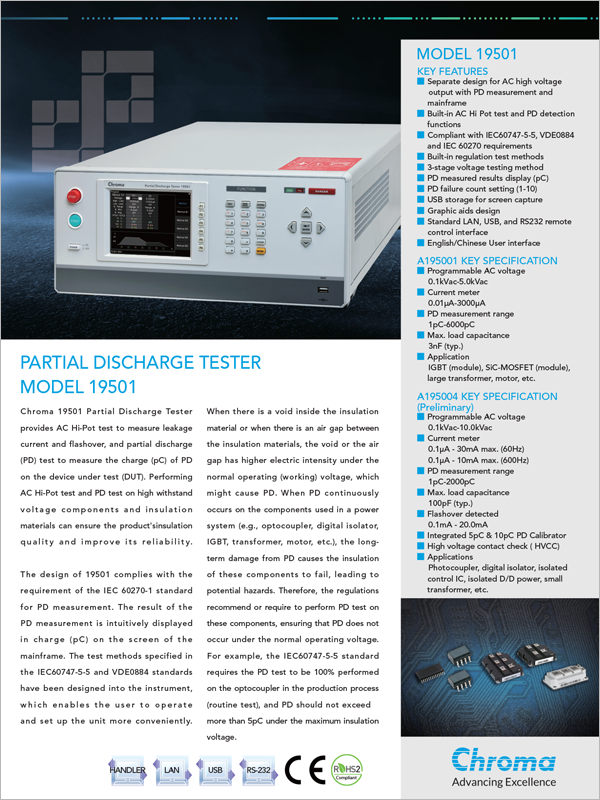
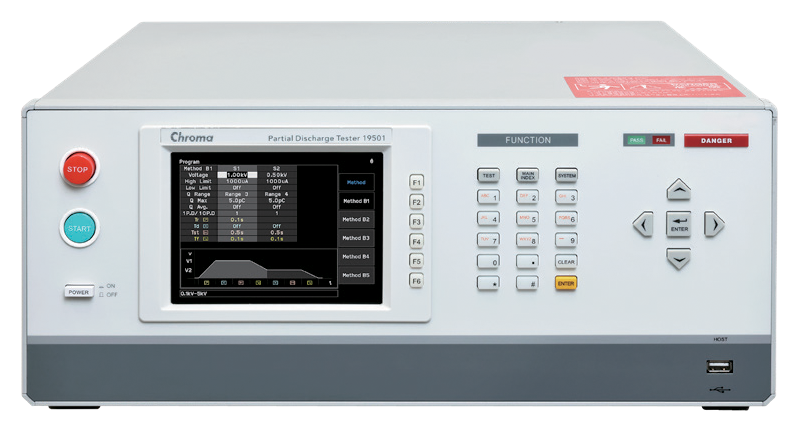
Chroma 19501 Partial Discharge Tester provides AC Hi-Pot test to measure leakage current and flashover, and partial discharge (PD) test to measure the charge (pC) of PD on the device under test (DUT). Performing AC Hi-Pot test and PD test on high withstand voltage components and insulation materials can ensure the product’s insulation quality and improve its reliability.

The design of 19501 complies with the requirement of the IEC 60270-1 standard for PD measurement. The result of the PD measurement is intuitively displayed in charge (pC) on the screen of the mainframe. The test methods specified in the IEC60747-5-5 and VDE0884 standards have been designed into the instrument, which enables the user to operate and set up the unit more conveniently.

When there is a void inside the insulation material or when there is an air gap between the insulation materials, the void or the air gap has higher electric intensity under the normal operating (working) voltage, which might cause PD. When PD continuously occurs on the components used in a power system (e.g., optocoupler, digital isolator, IGBT, transformer, motor, etc.), the long term damage from PD causes the insulation of these components to fail, leading to potential hazards. Therefore, the regulations recommend or require to perform PD test on these components, ensuring that PD does not occur under the normal operating voltage. For example, the IEC60747-5-5 standard requires the PD test to be 100% performed on the optocoupler in the production process (routine test), and PD should not exceed more than 5pC under the maximum insulation voltage.

Electrical Discharge Theory
Partial Discharge

When there is a void inside the insulation material or when there is an air gap between the insulation materials, the void or the air gap is prone to partial discharge (PD) under the normal operating (working) voltage, which can lead to insulation degradation and cause the insulation quality to be abnormal. Why does PD often appear at the voids inside the epoxy or the air gap between enameled wires? Because the relative permittivity of air is a lower than that of the insulation material, the capacitance of the void or air gap is lower than that of the insulating material, and therefore, the void or air gap will have a relatively high proportion of voltage. Additionally, under the same distance condition, the breakdown voltage of the void or air gap is lower than that of the insulation material. This electrical discharge, which occurs in the void or air gap (partial defects) while other insulation materials in series are remaining normal, is called partial discharge (PD).

When a sufficient test voltage is applied on the device under test (DUT), the charge quantity of PD is measured (in pC) by using PD measurement for checking whether the insulation material of the DUT has any potential risk of abnormal insulation quality. Therefore, applying the test voltage, which is slightly higher than the maximum rated working voltage of the component, for the PD test ensures the component’s quality and reliability (no continuous PD) for long-term operation under normal operating voltage.

A void in the insulation material

Ca: Equivalent capacitance of the insulation material (path without any void between the electrodes)
Cc: Equivalent capacitance of the void
Cb: Equivalent capacitance of the insulation material (path with void between the electrodes)

Application Explanation

IGBT and SiC-MOSFET, both power semiconductor devices, are used in various fields such as electronic products, industrial equipment, aerospace, military equipment, railway systems, energy applications, smart grids, electric vehicles, etc. They are frequently used in high-power conversion, large-current power conversion and power control circuits, which may have an operating voltage with several kilo-volts. Because they will be switched ON and OFF very frequently, there is a PWM (Pulse-Width Modulation) high voltage difference across between the gate and collector or between the gate and drain of the module, and as well as between the module and heatsink. When the high voltage is across the insulation materials that contain voids, air gaps, or cracks, there is a higher likelihood of PD occurring. After long-term operation, the insulation material will be gradually degraded, which will eventually lead to insulation failure of the material and cause product damage.

[Figure 1] Circuit diagram of a motor driver
[Figure 1] Circuit diagram of a motor driver

Additionally, the operating bias voltage (threshold voltage) between the Gate and Emitter or between the Gate and Source of each module may be provided by individual transformers. These transformers may have a high voltage difference with high frequency between their primary and secondary sides. When the insulation capability between the primary and secondary sides of a transformer is insufficient, the surges of continuous abnormal discharge may interfere with the digital control operations and result in transistor failure.

Although the wires used in the transformers may have sufficient withstand voltage capabilities (e.g., 3000V) by themselves, when the coils/wires on the primary and secondary sides are very close to each other, it may appear that the wires can withstand a relatively high voltage (e.g., 6000V). However, in fact, after operating a period under the typical voltage (e.g., 1000V), insulation failure may occur. Because the permittivity of the general wire’s insulation layer is much greater than that of air, the voltage division ratio across the air gaps between the wires is relatively high. When the voltage across the air gap between the wires is >350V (the discharge inception voltage for the shortest air distance at 1 atm), PD begins to occur on the partial surface between the wires. Because the insulation layer of the wires does not deteriorate or get damaged immediately, the insulation layer gradually carbonizes after continuous use over a period of time, ultimately leading to a short circuit on the primary and secondary sides of the transformer (Figure 4).

Photocouplers and digital isolators are used in various environments that require isolation. When the isolation voltage is applied across insulation materials that contain voids or cracks, the voltage across the voids or cracks may be sufficiently high to cause PD. After long-term degradation, the voltage isolation fails due to the insulation failure of the insulation material (Figure 5).

[Figure 2] Air gap and crack inside IGBT
[Figure 2] Air gap and crack inside IGBT
[Figure 3] Deterioration path (real photo)
[Figure 3] Deterioration path (real photo)
[Figure 4] PD occurs between the wires of primary and secondary coils of a transformer
[Figure 4] PD occurs between the wires of primary and secondary coils of a transformer
[Figure 5] PD occurs when void is present inside a photocoupler
[Figure 5] PD occurs when void is present inside a photocoupler
Measurement Technology
Partial Discharge Calibration

The PD tester is used for measuring and determining a tiny discharge quantity (in pC). Because this discharge signal is very small and rapid, the PD tester has to be precisely calibrated for ensuring the high frequency discharge signal can be accurately measured when the PD occurs.

U: High voltage supply
Z: Blocking impedance
Ca: Capacitance of DUT
Ck: Coupling capacitor
Zm: Input impedance of measuring system
CD: Coupling device
CC: Connecting cable
MI: Measuring instrument
PG: Step voltage generator
V0: Step voltage

Partial Discharge Calibration
HV Module (A195005 & A195004)

The HV modules offer precise and wide-range PD measurement. Different high-voltage modules can be selected based on the capacitance of the DUT and the requirements of PD measurement.

• The A195005 has four PD measurement Ranges (1 – 4), with a total PD measurement range from 1pC to 6000pC.
• The A195004 has two PD measurement levels, with a PD measurement range from 1pC to 2000pC.

After the test is completed, the mainframe will intuitively display the data and measurement results on the screen, aiding in the judgement and analysis of the discharge quantity.

19501 + A195005
19501 + A195005
PD test Fail screen
PD test Fail screen

The shape of the A195004 HV module has been designed as an isosceles trapezoid for the purpose of automation integration. This design allows multiple HV modules to be arranged in a fan-shaped configuration on the automated test system, which optimizes space usage. Additionally, the plug-in connection design brings the A195004 closer to the test socket, reducing test cable length (minimizing the impact of the cable on the test result). Moreover, the plug-in design makes insertion and removal of the HV module easier, and improves the convenience of maintenance and repair.

19501 + A195004
19501 + A195004
A195004 x 8 arranged in a circle
Anti-interference design

The HV modules (A195004 & A195005) measure the tiny discharge occurring on the DUT during the test. Because the duration of PD is very short and fast (in nS), the frequency of PD is very high, and the signal of PD is very small, high-frequency noise (e.g., electromagnetic waves) from the surrounding environment (e.g., mechanical operations, motor operations, etc.) can easily interfere with the measurement of tiny discharge, which causes measurement error, and affects the PD measurement and judgement. Reducing and preventing environmental interference with the PD measurement circuit is a significant challenge for product manufacturers and automation equipment makers. It is also a major technological challenge for the design of PD test instruments.

Anti-interference design (A195005)
EMI Shielding Cover (195005)

Because there may be unavoidable high-frequency noise in the test environment, test & measurement” and “operation & display” need to be separated. The HV modules are designed for the purpose of test & measurement, and the mainframe is designed for operation & display. This design allows the HV module to perform the measurement as close as possible to the DUT, which minimizes interference on the test cable by high-frequency noise from the surrounding environment. The measurement circuit is designed to isolate the noise signal, and makes the measurement circuit as short as possible. Additionally, the low voltage connection uses a coaxial cable to isolate the interference of environmental noise, and prevent the noise interference with the measurement circuit. Furthermore, a grounded metal shielding can be used to isolate the DUT from environmental noise and thereby ensure measurement accuracy.

Chroma 19501 + A195004 Separate design can reduce interference from high-frequency noise.

Chroma 19501 + A195004
Separate design can reduce interference from high-frequency noise.

Other Brand PD Tester Non-separate design necessitates using a longer test cable to contact the DUT, which more easily gets interference from high-frequency noise in the surrounding environment.

Other PD Tester
Non-separate design necessitates using a longer test cable to contact the DUT, which more easily gets interference from high-frequency noise in the surrounding environment.

Product Applications

Regulations require/suggest PD test for specific products and provide a reference formula for test voltage (Vpd) for the PD test. The PD test usually requires the maximum working isolation voltage or the maximum repetitive peak isolation voltage (whichever is higher) multiplied by 1.875 for the test voltage. The test voltage formula of PD test (Vpd):

3 Regulation-Compliant Test Methods

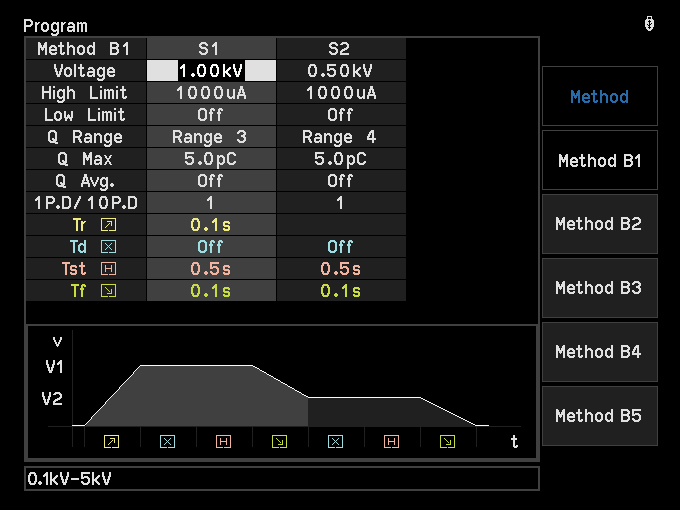
Chroma 19501 has built-in the regulation test methods (1), (2), and (3) as stipulated in the regulations. The bottom of the program page displays the diagram of the selected test method to assist users editing the parameters and selecting the test method, which allows them to get started easily and quickly.

Method (1)
Method (2)
Method (3)
Regulation 19501 Method (1) 19501 Method (2) 19501 Method (3)
IEC 60747-5-5
a, b1
b2
b3
IEC 60747-17
a, b1
b2
3-Stages Test Methods

Chroma 19501 has built-in 3-stage voltage test methods. This enables manufacturers to not only meet the regulation’s PD test requirements, but also the requirements of quality improvement by using a test voltage that is higher than the regulation’s PD test requirements. This test method starts with a withstand voltage test (1st test stage), then uses the test voltage that is higher than the regulation’s PD test requirements for a PD test (2nd test stage), and finally uses the test voltage (Vpd) which meets the regulation’s PD test requirements for a PD test (3rd test stage). This test method not only meets the regulation’s requirements but also improves product quality.

Method (4)
Method (5)
Application of High Frequency Voltage (A195004 Only)

High-frequency voltage has three main advantages:
(1) Increasing the frequency of output voltage increases the occurrence frequency of peak voltage, which can shorten the PD test time and improve productivity.
(2) Because the original insulation condition of the DUT may contain unstable factors (Ex. moisture, dust, burrs, etc.), which may lead to unstable PDIV results, the high frequency and high voltage can be used to pre-process the unstable factors of the DUT (pretreatment) in order to obtain more stable PDIV results. Higher voltage can be used to eliminate the unstable factors, and the higher frequency can be used for shortening the time cost of eliminating the unstable factors.
(3) When the weakness of the insulation quality needs to be analyzed or the location of the weaknesses needs to be identified, high frequency and high voltage can be used to deteriorate the insulation of the DUT. The higher voltage (> PDIV) can gradually degrade the insulation of the DUT, and the higher frequency can shorten the degradation time.

PD Count Judgement

When PD occurs, its signal is very small, and its measurement is easily interfered with by high-frequency noise from the surrounding environment. This is why the purpose of PD count judgement is to reduce misjudgments of test results caused by interference from external noise, and to confirm that the PD indeed happens on the DUT instead of merely being a one-time interference event from the environment. The PD occurring on/in the DUT is usually periodically due to the cyclical variation of voltage. Therefore, compared to high-frequency noise from the environment, the PD is relatively stable.

The Chroma 19501 is designed to count the occurrences of PD that persist over the Q Max limit for every half-cycle of the test voltage. There must be more than two occurrences of PD over the Q Max limit within every 5 consecutive half-cycles in order to accumulate the PD count. After the first PD exceeds the Q Max limit, there must be at least one additional PD over the Q Max limit within the subsequent 4 half-cycles (2 cycles) in order to accumulate the PD count. If not, the count will reset to zero and start over. When the PD count reaches/exceeds the set limit, it will judge the DUT as PD fail.

Example: PD count judgement is set to 5 P.D.
(1) Condition met: PD Count >5

PD > Q Max (ex. 5pC) occurs every half cycle. PD count = 5
PD > Q Max (ex. 5pC) occurs more than once within every 5 half cycles. PD count = 5. Count adds up when PD > Q Max occurs within every 4 half cycles.

(2) Condition not met: PD Count < 5

PD > Q Max (ex. 5pC) doesn't occur more than once within every 5 half cycles. If PD > Q Max (ex. 5pC) doesn't occur within every 4 half cycles, PD count resets to 0.
HVCC (High Voltage Contact Check)

It is very important to perform a contact check on high insulation components before the high voltage output. Chroma’s unique HVCC (High Voltage Contact Check) function uses Kelvin measurement to perform a contact check on the high insulation components before the high voltage output, which enhances the test reliability and productivity. The wiring circuit diagram is shown below.

Key Specifications
19501 + A195005
19501 + A195005

• Programmable AC voltage 0.1kVac ~ 5.0kVac
• Current meter 0.1μA ~ 3000μA
• PD measurement range 1pC ~ 6000pC
• Max. load capacitance 3nF(typ.)
• Application IGBT (module), SiC-MOSFET (module), large transformer, motor, etc.

19501 + A195004
19501 + A195004

• Programmable AC voltage 0.1kVac ~ 5.0kVac
• Current meter 0.1μA ~ 3000μA
• PD measurement range 1pC ~ 6000pC
• Max. load capacitance 3nF(typ.)
• Application IGBT (module), SiC-MOSFET (module), large transformer, motor, etc.

Model Options

Model Description
19501 Partial Discharge Tester
19501S Partial Discharge Tester
A195001 PD Calibrator
A195005/td> HV Module
A195004 HV Module

Watch

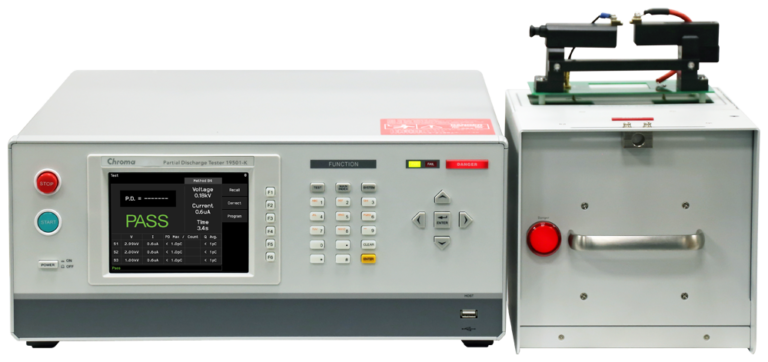
Chroma Partial Discharge Tester 19501

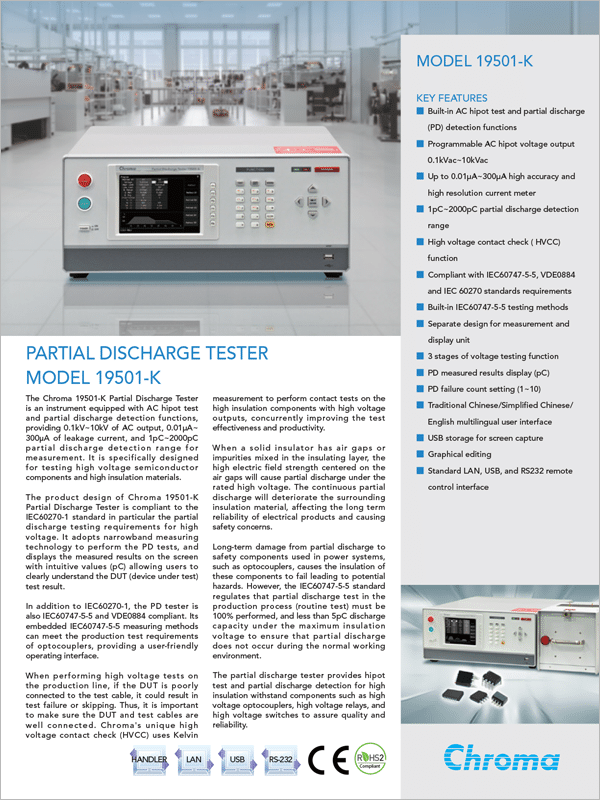
The Chroma 19501-K Partial Discharge Tester is an instrument equipped with AC hipot test and partial discharge detection functions,it is specifically designed for testing high voltage semiconductor components and high insulation materials. In addition, the product design is compliant to the IEC60270-1 standard in particular the partial discharge testing requirements for high voltage and embedded IEC60747-5-5 measuring methods can meet the production test requirements, providing a user-friendly operating interface.

Related Products

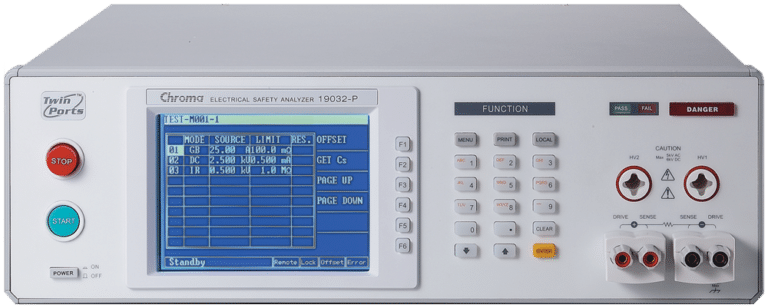
Partial Discharge Tester

Chroma 19501

0.3 to 99.9 sec., steps 0.1 sec.

±(0.2% of setting + 10ms)

0 to 99.9 sec., steps 0.1 sec.

Provides AC Hi-Pot test to measure leakage current and flashover, and partial discharge (PD) test to measure the charge (pC) of PD on the device under test (DUT)

Guardian Ground Bond Tester

Chroma 19572

AC: 3~45A

0.1~510 mΩ

50Hz / 60Hz

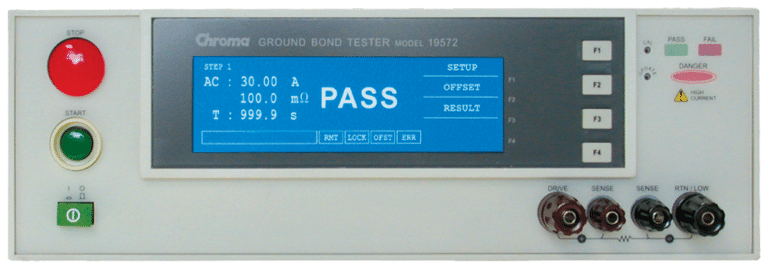
Provides high current testing of ground continuity between chassis and power cord ground on a wide variety of electrical products and appliances

Guardian Multi-Channel Hipot Tester

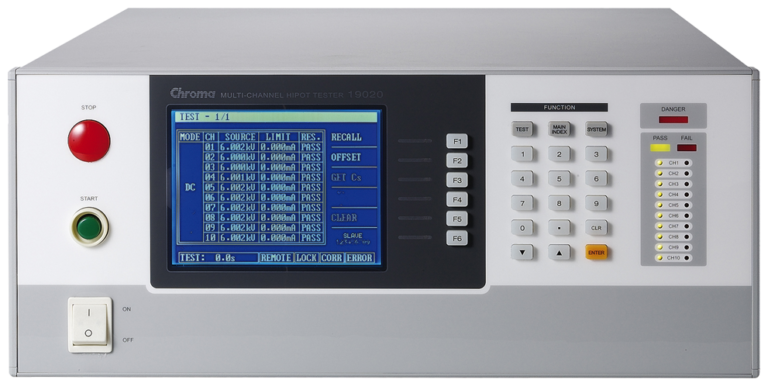
Chroma 19020

AC or AC / DC / IR

10 (up to 100)

AC: 0.05kV~6kV
DC: 0.05kV~8kV

Measure the hipot leakage current of all channels at the same time and conduct tests on up to 100 DUTs simultaneously

Guardian Hipot Tester AC/DC/IR/SCAN

Chroma 19050

AC / DC / IR
or AC / DC / IR / SCAN

1, 4 or 8

AC: 0.05~5kV
DC: 0.05~6kV

Advanced digital hipot testers with load and line regulations that help ensure measurement integrity, and Multi-step capability allows users to perform multiple tests in sequence

Guardian Hipot Analyzer

Chroma 19055

AC: 0.05~5kV
DC: 0.05~6kV

AC: 5kV/100mA (4kV/120mA)
DC: 25mA

0.1MΩ~50GΩ / 5kV max

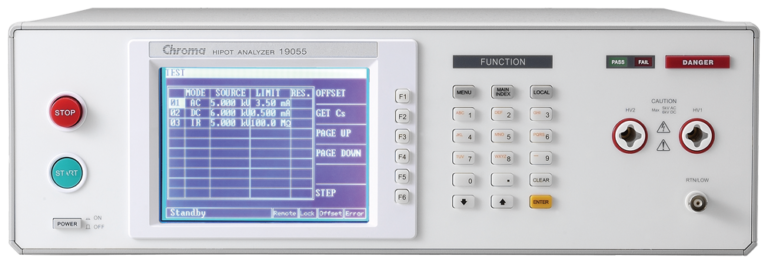
Designed for hipot tests and analysis of transformers, motors and other electronic components

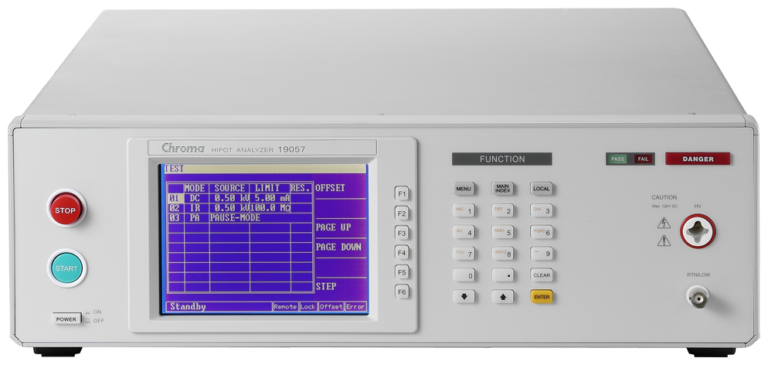
Guardian Hipot Analyzer

Chroma 19056/19057

AC: 0.1~10kV (19056)
DC: 0.1~20kV (19057)

AC: 20mA (19056)
DC: 10mA (19057)

0.1MΩ~50GΩ / 5kV max

Provides high withstand voltage test and analysis for optical couplers, HV relays, HV switches, and PV modules components, which have better insulation capability

Sentry Hipot Tester AC/DC/IR

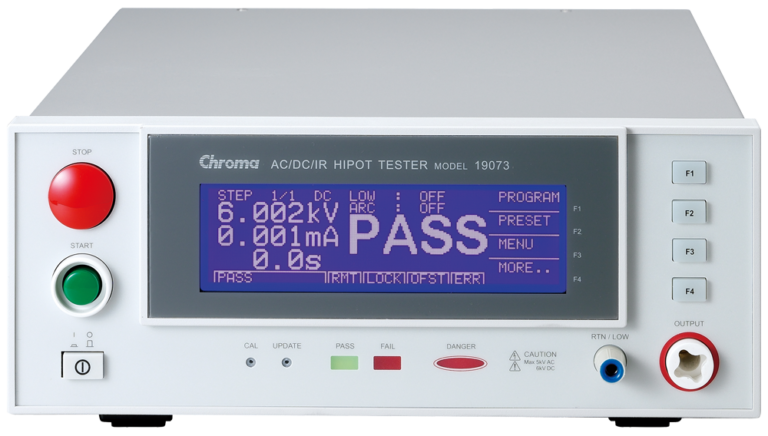
Chroma 19070

AC or AC / DC / IR

1

AC: 0.05~5kV
DC: 0.05~6kV

Compact, lightweight, and low-cost hipot tester for electronic components

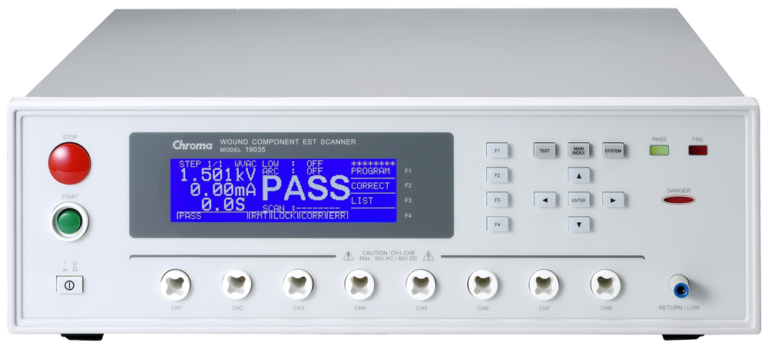
Hybrid Wound Component EST Scanner

Chroma 19035

AC / DC / IR / DCR -8CH

8 (up to 40 opt.)

AC: 0.05~5kV
DC: 0.05~6kV

Powerful functions for Flashover detection and Open/Short Check (OSC) with programmable voltage and time parameters for various characteristics of DUTs

Wound Component EST Analyzer

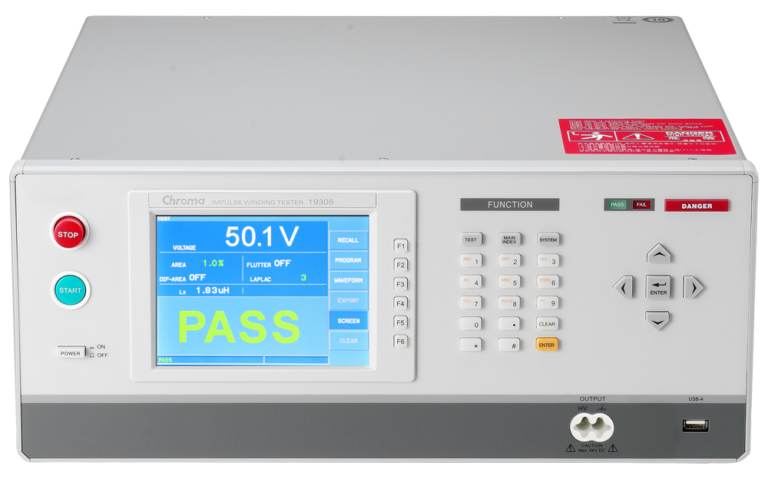
Chroma 19036

AC / DC / IR /
Impulse (surge) / DCR

10 (up to 40 opt.)

AC: 0.05~5kV
DC: 0.05~6kV

Impulse winding test imposes a non-destructive, high speed and low energy voltage impulse on the device under test for analysis and comparison

Electrical Safety Analyzer

Chroma 19032

AC: 0.05~5kV
DC: 0.05~6kV

DC: 12mA , AC: 40mA (19032)
DC: 25mA , AC: 100mA (19032-P)

0.1MΩ~50GΩ / 1kV max

The test-to-any-standard electrical safety analyzer. Easy, precise testing. A must for medical device testing and IQOQ compliance.