Hipot Testers (High Voltage Testers) for Electrical Safety Compliance
Chroma hipot testers provide accurate, repeatable high-voltage testing for verifying the insulation integrity and electrical safety of components, assemblies, and finished products. Choose from AC and DC dielectric withstand testers, insulation resistance testers, multi-channel hipot systems, ground bond testers, and advanced electrical safety analyzers for R&D, quality assurance, and production-line testing.
With programmable test sequences, precise leakage-current measurement, arc detection, operator safety features, and automation-ready interfaces, Chroma hipot testing equipment helps manufacturers improve test consistency, increase throughput, and meet applicable IEC, UL, CSA, EN, and other electrical safety requirements.
What is a Hipot Tester?
A hipot tester—also called a high-potential tester, dielectric withstand tester, or high-voltage tester—applies a controlled voltage between electrically isolated conductors or between a conductor and protective earth. The instrument monitors leakage current to determine whether the device’s insulation can withstand the specified test voltage without excessive current flow, flashover, or electrical breakdown. Hipot testers and analyzers are built to detect insulation weaknesses, leakage current issues, manufacturing defects, and contamination or material degradation. Learn More
How to choose the right hipot tester
Compare Chroma Hipot Testers and Electrical Safety Analyzers
Start with the electrical safety tests required by your product standard: AC or DC dielectric withstand, insulation resistance, leakage current, ground bond, impulse winding, DC resistance, or partial discharge. Then compare output voltage and current, channel count, DUT type, automation needs, and production throughput. Use the guide below to identify the Chroma hipot tester or analyzer best suited for benchtop testing, quality assurance, automated production, medical-device compliance, high-voltage components, and wound-component evaluation.
Need general-purpose hipot testing?
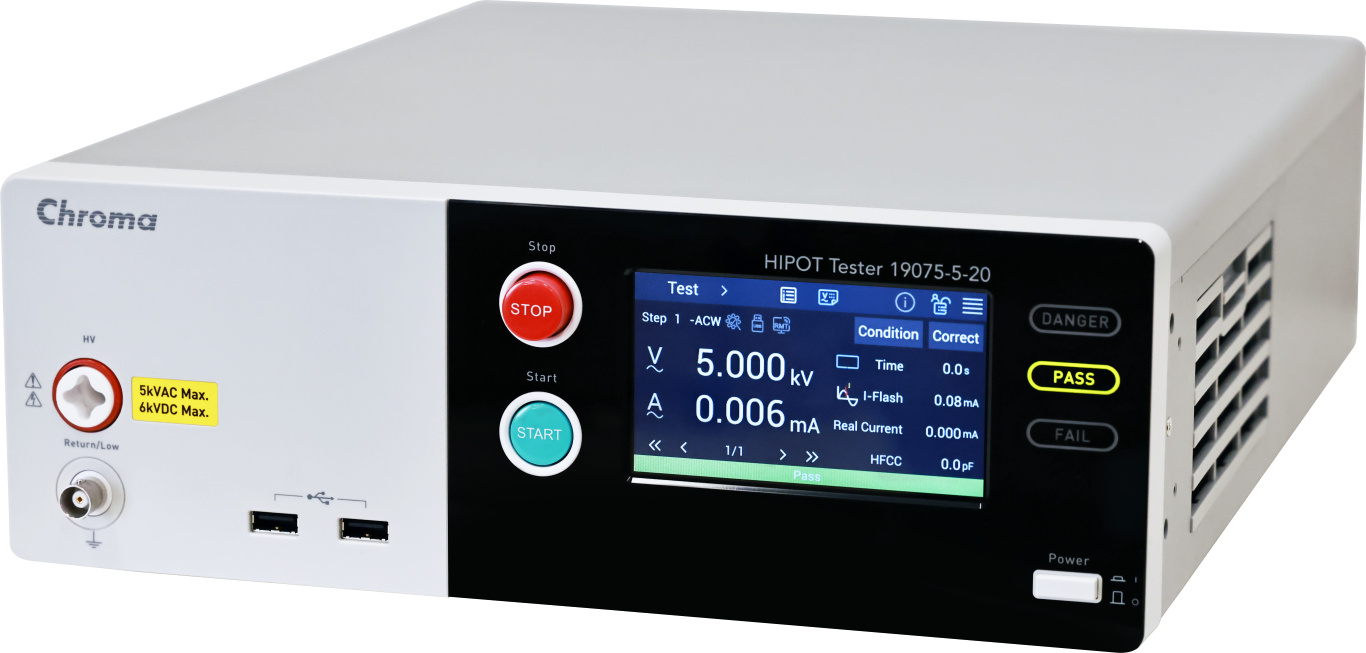
Start with the 19070 for compact AC/DC/IR testing or the 19050 for programmable sequences and scanning.
Need a complete safety analyzer?
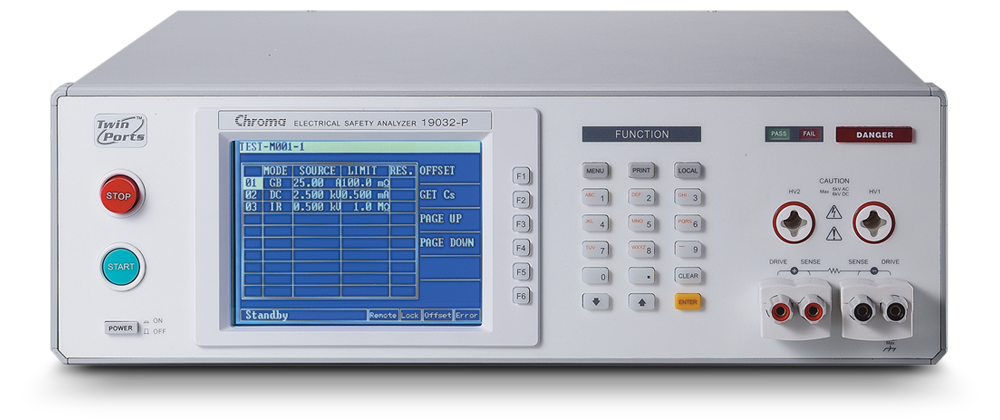
Choose the 19032 for multi-function electrical safety testing, including medical-device and IQOQ workflows.
Need higher throughput?
Use the 19020 for parallel multi-DUT testing or a scanner-equipped 19035/19036 for wound components.
Testing specialized insulation?
Compare the 19056/19057 for higher test voltages, the 19300 Series for windings, or the 19501 Series for partial discharge.
| Product family | Test functions | Channels | Output / range | Best fit | Why choose it | Next step |
|---|---|---|---|---|---|---|
19070Sentry Hipot Tester AC/DC/IR |
AC or AC/DC/IR, model dependent | 1 | AC: 0.05–5 kV DC: 0.05–6 kV |
Electronic components, benchtop testing, incoming inspection, and cost-conscious production stations. | Best entry point Compact, lightweight platform for essential dielectric withstand and insulation resistance tests. |
Explore |
19020Guardian Multi-Channel Hipot Tester |
AC or AC/DC/IR, model dependent | 10; expandable to 100 | AC: 0.05–6 kV DC: 0.05–8 kV |
High-throughput production testing of multiple DUTs or multiple test points. | Best parallel throughput Measures leakage current across all channels simultaneously and can test up to 100 DUTs. |
Explore |
19050Guardian Hipot Tester AC/DC/IR/SCAN |
AC/DC/IR; scanning on select models | 1, 4, or 8 | AC: 0.05–5 kV DC: 0.05–6 kV |
Automated production, multi-point assemblies, and programmable multi-step test sequences. | Best general-purpose series Combines regulated output, sequencing, and optional scanning for repeatable production tests. |
Explore |
19032 / 19032-PGuardian Electrical Safety Analyzer |
AC/DC hipot, IR, leakage current, ground bond, and functional tests; configuration dependent | Single DUT; scanner options available | AC: 0.05–5 kV DC: 0.05–6 kV IR: 0.1 MΩ–50 GΩ |
Medical devices, appliances, laboratory equipment, compliance testing, and IQOQ documentation. | Best complete safety platform Choose when one programmable system must perform several electrical safety tests. |
Explore |
19055Guardian Hipot Analyzer |
AC/DC hipot and IR analysis | 1 | AC: 0.05–5 kV, up to 100 mA at 5 kV DC: 0.05–6 kV, 25 mA IR: 0.1 MΩ–50 GΩ |
Transformers, motors, and components requiring higher-output hipot analysis. | Best high-current analyzer Higher AC/DC output current supports DUTs with greater leakage or capacitance. |
Explore |
19056 / 19057Guardian High-Voltage Hipot Analyzers |
AC hipot (19056) or DC hipot (19057), plus IR | 1 | 19056: 0.1–10 kV AC, 20 mA 19057: 0.1–20 kV DC, 10 mA IR: 0.1 MΩ–50 GΩ |
Optocouplers, high-voltage relays and switches, PV module components, and high-insulation DUTs. | Best maximum voltage Use when conventional 5–6 kV hipot capability is insufficient. |
Explore |
19035Hybrid Wound Component EST Scanner |
AC/DC hipot, IR, DCR, flashover, and open/short check | 8; expandable to 40 | AC: 0.05–5 kV DC: 0.05–6 kV |
Motors, stators, transformers, heaters, solenoids, and other wound components. | Best EST scanner Combines multi-channel electrical safety and winding checks for production inspection. |
Explore |
19036Wound Component EST Analyzer |
AC/DC hipot, IR, impulse winding, DCR, and flashover detection | 10; expandable to 40 | AC: 0.05–5 kV DC: 0.05–6 kV Impulse: up to 6 kV |
High-power motors, stators, transformers, and production lines needing combined safety and winding tests. | Best all-in-one winding analyzer Combines high-power hipot, impulse, insulation resistance, and four-wire DCR measurement. |
Explore |
19301APower Inductor Impulse Winding Tester |
Low-energy impulse winding test | 1 | 10–1000 V Inductance: 0.1–100 µH |
Power inductors and low-inductance wound components. | Best for power inductors Low-capacitance impulse testing helps identify winding defects with low test energy. |
Explore |
19305Impulse Winding Tester |
Impulse winding waveform comparison | 1 | 200 MHz sampling For inductance greater than 10 µH |
Motors, transformers, coils, and wound components requiring high-speed waveform analysis. | Best impulse waveform analysis High-speed sampling reveals layer shorts and other winding defects that may evade conventional tests. |
Explore |
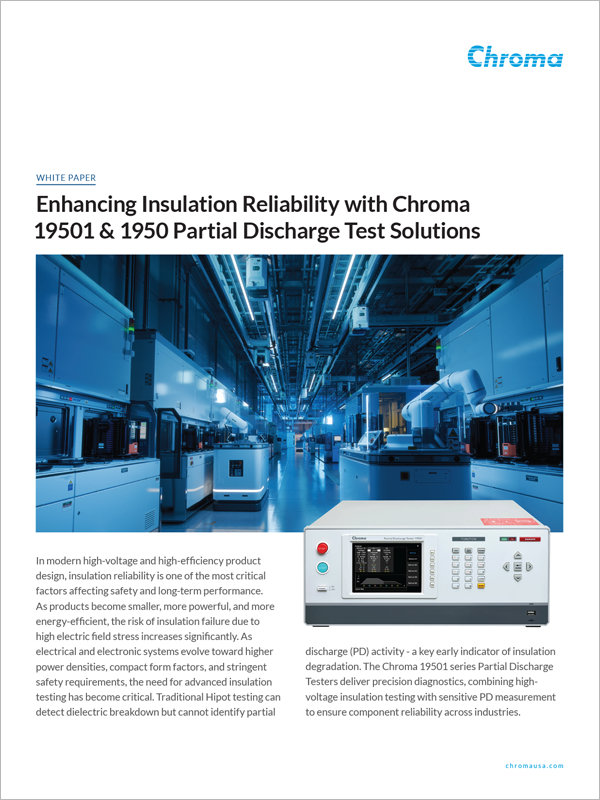
19501Partial Discharge Tester |
AC hipot, leakage current, flashover, and partial-discharge measurement | 1; paired with HV module | Module dependent: up to 5 or 10 kV AC PD: 1–6000 pC or 1–2000 pC |
IGBT and SiC modules, isolators, transformers, motors, and insulation systems. | Best configurable PD system Selectable HV modules support different voltage, capacitance, frequency, and DUT requirements. |
Explore |
19501-KPartial Discharge Tester |
Partial-discharge testing | 1 | 0.10–10.00 kV PD: 1–200 pC |
High-voltage semiconductor components and high-insulation materials. | Best focused PD tester Dedicated measurement platform for evaluating small partial-discharge levels at high voltage. |
Explore |
19572Guardian Ground Bond Tester |
Ground bond and protective-earth continuity | 1 | 3–45 A AC Resistance: 0.1–510 mΩ 50/60 Hz |
Appliances, electrical products, chassis, and power-cord grounding verification. | Best ground-path verification High-current testing confirms low resistance between exposed conductive parts and protective earth. |
Explore |
No products match this filter. Select another test type or view all hipot testers and analyzers.
Not sure which hipot tester fits your safety test requirements?
Share your required test functions, voltage, current, channel count, DUT type, applicable standard, interfaces, and production rate with a Chroma sales engineer.
Get help choosing

Looking for Battery Cell Safety Testers?
A battery cell insulation tester accurately measures leakage current (LC) and insulation resistance(IR) of battery jelly-roll/dry-cell as well as other insulation materials. The tester includes partial discharge (PD) and flashover detection to identify defects and potential hazards. Our Surge Tester is designed for testing the insulation quality between the positive and negative plates of a lead-acid battery cell.
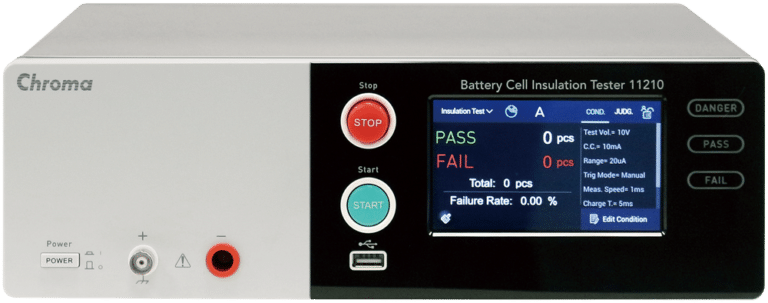
Battery Cell Insulation Tester
Chroma 11210
Up to 1KV(DC)
50mA max.
0.01kΩ~10 TΩ [kΩ, MΩ, GΩ]
The Chroma 11210 battery cell insulation tester accurately measures leakage current (LC) and insulation resistance (IR) of battery jelly-roll/dry-cell as well as other insulation materials.
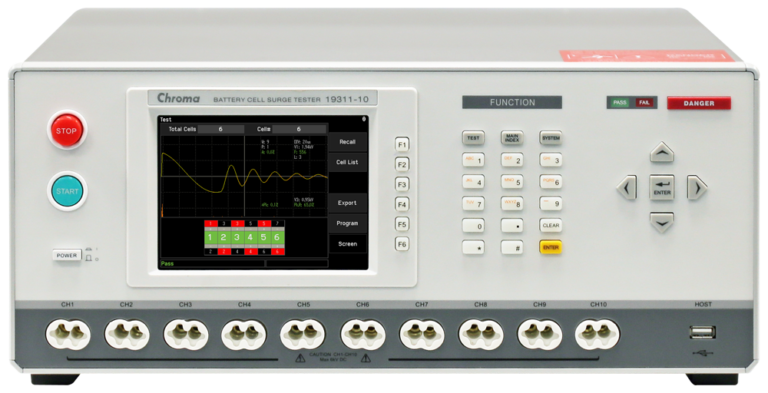
Battery Cell Surge Tester
Chroma 19311
0.10 kV~6.00 kV, 0.01 kV
≥ 3.00kV @ 50nF
200MHz
Designed for testing the insulation quality between the positive and negative plates of a lead-acid battery cell
Battery Cell Safety Testing
While lithium-ion MFG has matured, electrical shorts can still develop inside the cell after passing production tests due to burrs or particles on the positive electrode. If these cells, which are susceptible to failure, reach the end user, the results could be catastrophic.
Watch this video to learn how to identify and mitigate these occurrences in the dry cell stage before electrolytes are introduced.
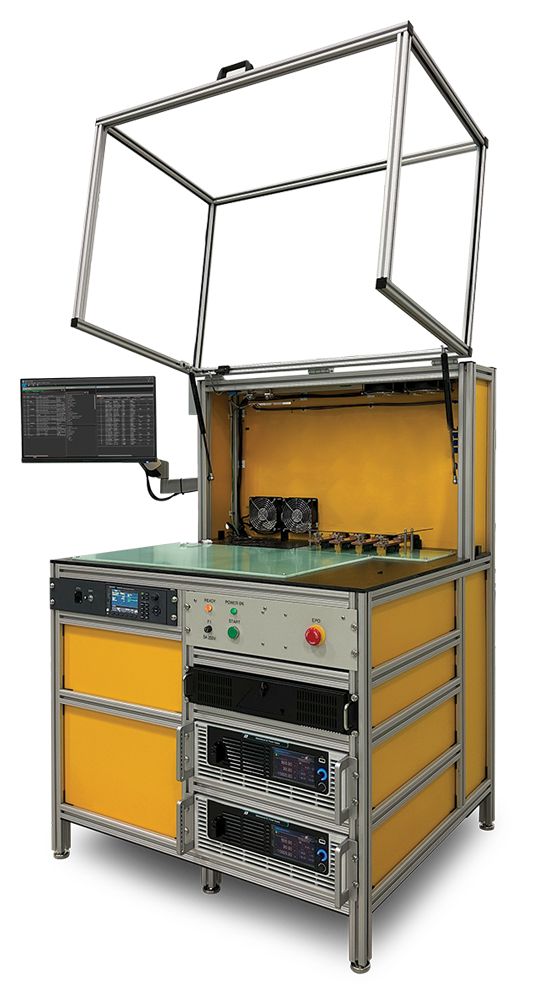
High Voltage Safety Enclosures
Designed to provide a safe environment for Hipot testing devices, these high voltage safety enclosures act as personal protective equipment (PPE), reduce the hazard of high voltage discharge and safeguard operators from the dangers associated with High Potential Testing. These come equipped with a magnetic safety interlock switch and chassis ground connection that must be wired from the safety tester to the safety enclosure for safe operation.
Electrical Safety Test Application Notes
Browse application notes on the topic of Electrical Safety Testing. Chroma’s application notes provide insight and context to assist test engineers with a particular technology, instrument, or application for their bench-top, R&D, design verification and/or ATE requirements and specifications.