
From performance validation during R&D to quality assurance and safety margin validation during mass production, every stage of lithium-ion battery testing requires adequate safety measures to control hazards arising during the testing process. To simulate battery performance under different conditions, test systems are often paired with suitable environmental chambers. While testing methods vary, users primarily focus on two key points when selecting a charge/discharge test system: (1) controlling potential risks during the testing process, and (2) maintaining high test accuracy and efficiency, all essential to ensuring reliable test results while safeguarding operator safety.
To meet these two conditions, it is necessary to consider not only the performance of the charge/discharge equipment but also the integration of the environmental chamber system in the overall planning. Only then can a truly safe, reliable, one-stop charge/discharge test solution be achieved.
How should battery cell testing teams differentiate and protect against various levels of hazards?

The European Council for Automotive R&D (EUCAR) provides a Hazard Level (HL) rating for lithium-ion batteries, clearly defining the characteristics and environmental risks associated with each level from HL1 to HL7. This classification is now widely used in the environmental test chamber industry.
For example, HL5 indicates a battery risk involving fire or flames without rupture or explosion, meaning there are no flying parts. In this case, users can install the recommended safety equipment in the environmental chamber (as shown in Table 1 below) to contain hazards within a controllable range. Additionally, the system encompassing the environmental chamber and charge/discharge equipment should incorporate a predefined safety and control process. Such a process includes: 1. Fire monitoring, 2. Fire alert, 3. Fire control, and 4. Post-incident verification, preventing human errors that could lead to additional hazards.
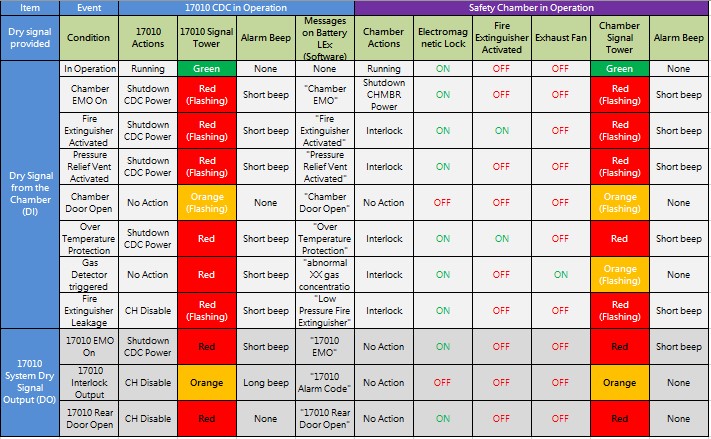
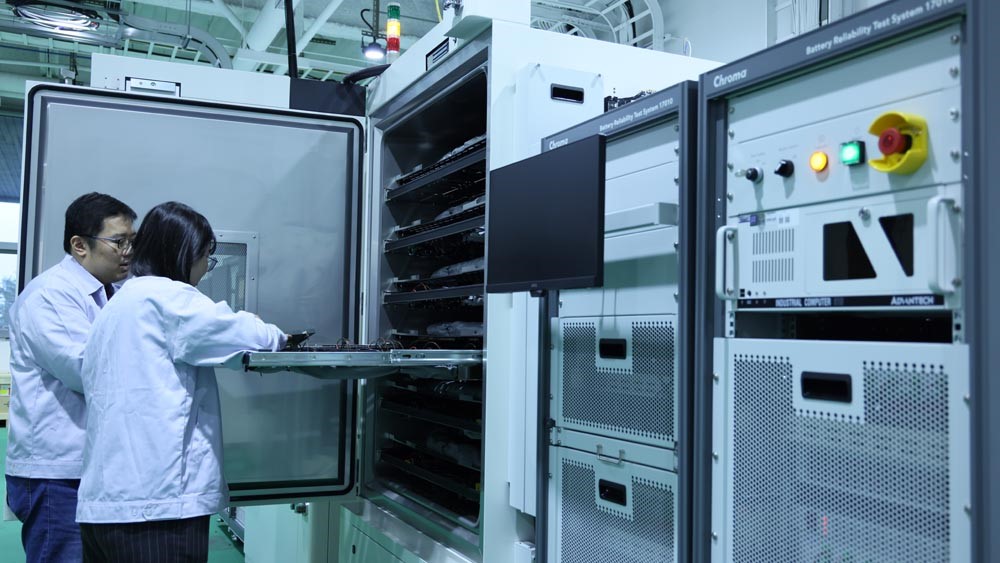
The Chroma 17010/17010H Battery Cell Charge/Discharge Test System has been adopted and endorsed by major battery cell manufacturers, automotive companies, and energy storage system providers worldwide. This is due not only to its high accuracy in charge and discharge measurements, low output noise, and multi-layered software and hardware safety features, but also to its flexible integration of control commands for safety-oriented environmental chambers. Based on a robust safety control matrix (Table 2 below), this one-stop test system enables the chamber and charge/discharge equipment to communicate through signal interlocks and thereby contain testing hazards in real-time as they occur, helping personnel safely complete their battery testing tasks.