Evolving Power Architectures for AI Servers: From UPS through BBUs to High-Voltage Solutions
AI data centers rely on increasingly power-hungry GPUs and other accelerators to handle demanding compute workloads. To keep servers running reliably under these heavier demands, the industry is shifting from traditional UPS systems to BBUs (Battery Backup Units) for more efficient and responsive backup power.
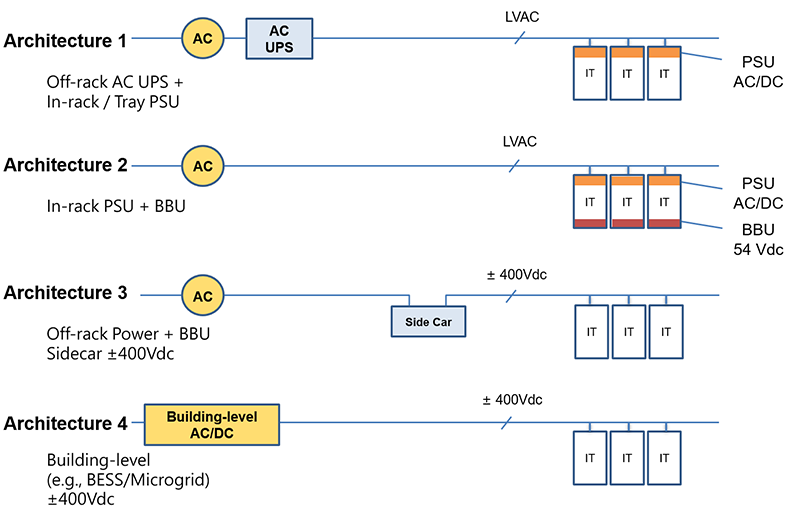
BBU modules are typically built on a 48V lithium battery architecture, and are integrated directly into IT racks to reduce AC-DC conversion losses and maintain stable operation. With the rapid growth of AI workloads, backup power is now advancing toward ±400V high-voltage systems to further improve power supply performance.
Emerging designs include the Sidecar configuration–where a disaggregated power rack is deployed alongside the IT rack–and building-level integration, where high-voltage power supplies are merged with the data center’s power infrastructure to optimize stability and efficiency. These advancements not only meet AI servers’ growing energy demands but also lay the groundwork for future innovations in AI technology.
BBU Module Reliability Test Standards
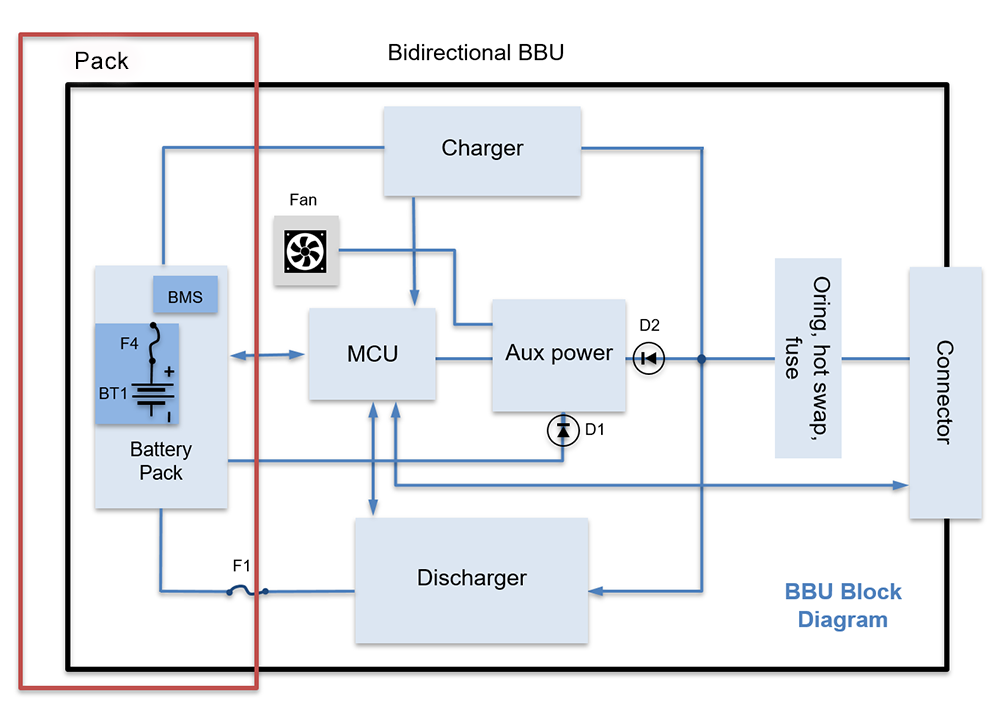
A BBU module consists of a lithium battery pack (‘core pack’), a BMS (Battery Management System), and a high-efficiency DC-DC converter. The battery pack serves as the main energy storage unit, while the BMS continuously monitors battery conditions. The system must comply with the UL 9540 standard to ensure overall safety. In the event of a power interruption, the BBU’s DC-DC converter immediately detects a drop in DC Bus voltage and switches to BBU power to maintain server operation. This allows data cached in DRAM to be written to backup SSDs, preventing data loss and ensuring zero-risk backup.
Performance and reliability testing can be conducted in accordance with Open Compute Project (OCP) standards, which emphasize rapid mode switching and long-term stability. According to OCP requirements, the BBU module must dynamically adjust charging current based on cell status (e.g., cell voltage, triggered protections) to ensure optimal charging behavior.
Discharge performance requirements include:
- 5.5kW output: discharge time ≥ 90 seconds
- 4kW output: discharge time ≥ 240 seconds
Regenerative Charge/Discharge Test System – Battery Pack Verification for BBU Modules
Chroma’s regenerative charge/discharge test systems provide comprehensive solutions for both low- and high-voltage BBU modules.
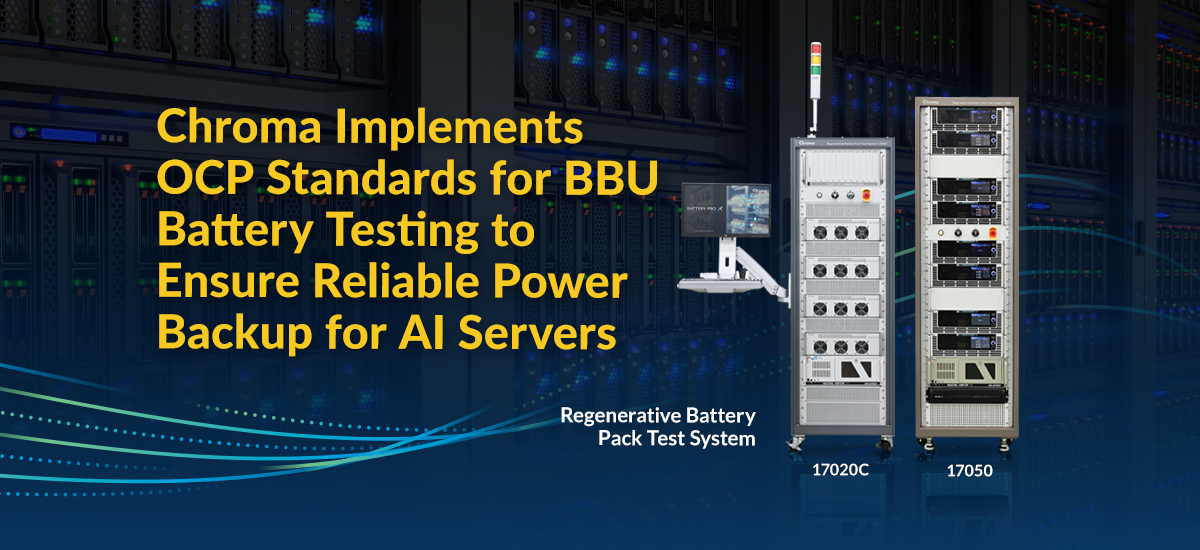
- 48V Low-Voltage BBU systems: Chroma 17020C features a 10kW single-channel design with automatic dual-range switching for flexible and diverse applications.
- ±400V High-Voltage BBU systems: Chroma 17050 combined with the 62000D-HL bidirectional DC power supply meets high-voltage, high-power testing demands.
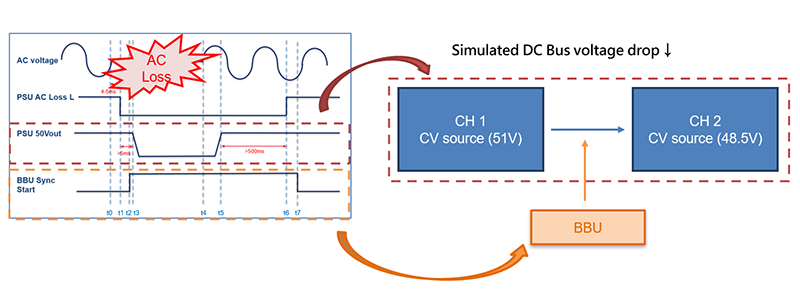
In addition to assessing BBU capacity, charge/discharge performance, and long-term durability, Chroma’s 17020C/17050 test systems also enable highly realistic simulation of actual server environments, ensuring accurate and dependable test results. In a typical server power system, the PSU converts AC to 48V DC to supply power to rack devices, while the BBU connects to the DC Bus via a DC-DC converter, constantly monitoring voltage levels. When the Bus voltage drops to a defined threshold, the BBU must initiate discharge within a defined time window to maintain uninterrupted operation.
The test system’s built-in Constant Voltage (CV) mode accurately reproduces DC Bus voltage fluctuations in server racks to simulate such exact scenarios. Users can configure one channel to supply a 51V CV source and another to simulate a 48.5V CV load, replicating real-world rack operation during a power outage. When the AC line fails and the Bus voltage drops from 51V down to the 48.5V threshold, the system automatically triggers the BBU’s discharge mode, continuously monitoring its response time and performance. This end-to-end solution faithfully replicates data center conditions and allows users to verify BBU performance and reliability well ahead of deployment.
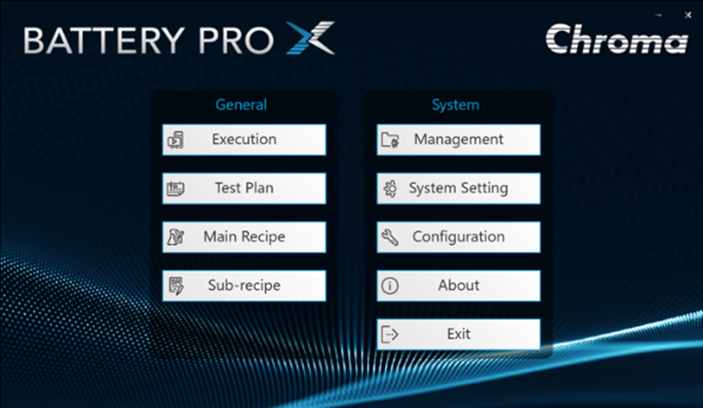
Chroma’s Battery Pro X test software features a brand-new interface, offering an intuitive, visual user experience that greatly shortens the learning curve. It also supports easy integration with third-party devices and provides real-time test monitoring, allowing users to efficiently track progress for improved operational efficiency and overall test accuracy.