

With the rapid development of cloud computing, AI, and high-performance computing (HPC), backup power in data centers is gradually shifting from uninterruptible power supplies (UPS) to battery backup units (BBUs). Instead of lead-acid batteries used in UPS systems, BBUs adopt lithium-ion battery designs. These offer higher energy density and better power conversion efficiency, capable of meeting stringent requirements in terms of both power and space in data centers. To ensure stable backup power can be supplied immediately during a power interruption—preventing service downtime and substantial economic losses—a stable, reliable BBU has become a critical focus for the server industry. The Chroma 17050 Battery Charge/Discharge Test System provides a highly effective, reliable, and safe all-in-one BBU testing solution, helping customers reduce the cost of testing while improving overall product quality.
In data centers adopting the Open Compute Project’s Open Rack V3 specification (OCP ORV3), a BBU typically consists of a lithium-ion battery pack, a battery management system (BMS), and a highly efficient DC-to-DC converter, forming an essential part of the server power architecture. Featuring grid-characteristic simulation capabilities, the Chroma 17050 can fully replicate operating conditions defined by OCP ORV3 and supports a wide range of test applications:
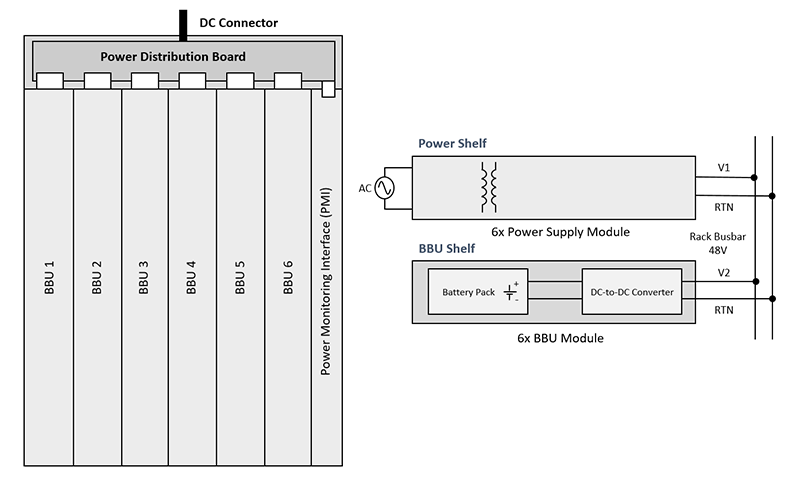
- Charge/discharge performance testing: Verifies whether the BBU can quickly enter discharge mode and deliver stable output during power anomalies or voltage sag events, ensuring uninterrupted data center operation.
- Capacity testing: Confirms the BBU’s sustained backup power capability during outages or power faults.
- Cycle life and durability testing: Simulates repeated power-transfer scenarios to validate the long-term reliability of BBU.
When paired with Chroma’s Battery Pro X software, recipes can be edited flexibly. By binding the channel to the BMS, data from the DUT can be captured and recorded to meet specific BBU testing requirements, such as voltage, current, power, status of charge (SOC), and battery management system (BMS) information. Data acquisition, execution cutoff, and protection judgment can all be performed in less than 10ms. In addition, the real-time monitoring mechanism helps users track battery test status or anomaly alerts to ensure operational safety and data accuracy. The system can also be integrated with third-party chambers and chillers to control temperature and humidity—thereby reducing fragmented operations across multiple devices, lowering operational complexity, and effectively shortening setup and operation time.
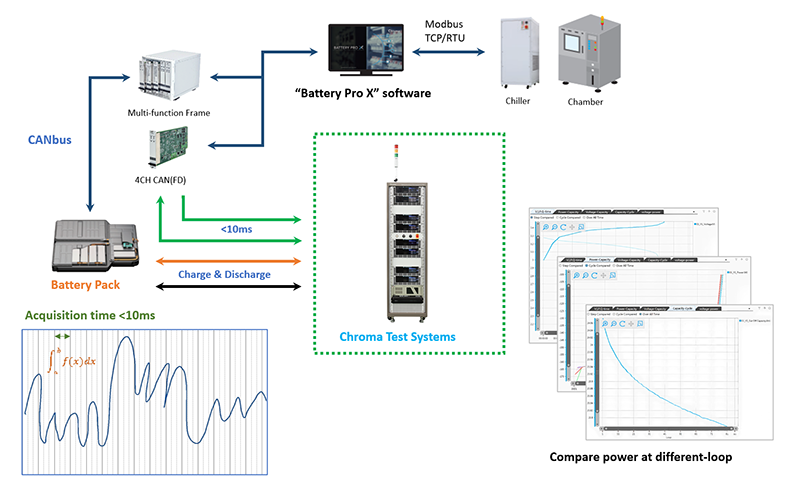
The Chroma 17050 is not only a BBU testing system but also sets a new benchmark for BBU performance. driving the data center industry towards higher efficiency, intelligence, and green energy. Through flexible recipe editing, rapid data acquisition, and real-time monitoring, it helps users comprehensively improve the efficiency and quality of BBU testing.